Cellular and Humoral Immunological Response Among Kidney Transplant Recipients After Messenger-RNA-COVID-19 Vaccination: A Systematic Review and Meta-Analysis
Cellular and Humoral Immunological Response Among Kidney Transplant Recipients After Messenger-RNA-COVID-19 Vaccination: A Systematic Review and Meta-Analysis
Ruangrong Cheepsattayakorn 1, Attapon Cheepsattayakorn2,3*, Porntep Siriwanarangsun 2
1. Department of Pathology, Faculty of Medicine, Chiang Mai University, Chiang Mai, Thailand.
2. Faculty of Medicine, Western University, Pathum Thani Province, Thailand.
3. 10th Zonal Tuberculosis and Chest Disease Center, Chiang Mai, Thailand.
*Correspondence to: Attapon Cheepsattayakorn, 10th Zonal Tuberculosis and Chest Disease Center, 143 Sridornchai Road, Changklan, Muang, Chiang Mai, 50100, Thailand.
Copyright
© 2023 Attapon Cheepsattayakorn. This is an open access article distributed under the Creative Commons Attribution License, which permits unrestricted use, distribution, and reproduction in any medium, provided the original work is properly cited.
Received: 28 July 2023
Published: 15 September 2023
Abstract
A comprehensive search was carried out in mainstream bibliographic databases or Medical Subject Headings, including ScienDirect, PubMed, Scopus, and ISI Web of Science, following PRISMA 2020 Guideline. The search was applied to the articles that were published between 2021 and mid-2023. With strict literature search and screening processes, it yielded 7 articles from 349 articles of initial literature database. A number of previous studies demonstrated that KTRs or non-KTRs with renal failure markedly reduced vaccine response, whereas adaptive protocols of mRNA COVID-19 vaccination or alternative adjuvant vaccines is now not known yet. A recent study revealed that acute kidney injury and mortality could be caused by SARS-CoV-2 (COVID-19) around 50 % and 23 % of the infected KTRs.
In conclusion, among the immunocompromised population, including KTRs, DPs, PDs, at least three doses of mRNA-COVID-19 vaccination was recommended to be the preparation of choice. Withdrawal of the immunosuppressants in KTRs and immunocompromised individuals prior COVID-19 vaccination and at least third dose of mRNA-COVID-19 vaccination should be performed.
Keywords: Cellular, Humoral, Immune, Response, Kidney, Transplant, Hemodialysis, COVID-19, Vaccine, mRNA
Cellular and Humoral Immunological Response Among Kidney Transplant Recipients After Messenger-RNA-COVID-19 Vaccination: A Systematic Review and Meta-Analysis
Abbreviations:
BAU : Bioequivalent Allergy Unit, BMI : Body-Mass Index, CI : Confidential Interval, CNI : Calcineurin Inhibitor, COVID-19 : Coronavirus-2019, DNA : Deoxyribonucleic Acid, DP : Dialysis Patient, eGFR : estimated Glomerular Filtration Rate, HCs : Healthy Controls, IgA : Immunoglobulin A, IgG : Immunoglobulin G, IFNγ : Interferon Gamma, IGRA : Interferon Gamma Assay, IN-KTRs : Infection-Nai?ve Kidney Transplant Recipients, IQR : Interquatile Rank, KTRs : Kidney Transplant Recipients, MMF : Mycophenolate Mofetil, MPA : Mycophenolic Acid, mRNA : messenger Ribonucleic Acid, NPV: Negative Predictive Value, OR : Odds Ratio, p : Probability, PD : Peritoneal Dialysis, PI-KTRs: Previously-Infected Kidney Transplant Recipients, PPV : Positive Predictive Value, PRISMA : Preferred Reporting Items for Systematic reviews and Meta-Analyses, RBD : Receptor-Binding Domain, ROC: Receiver Operating Curve, SARS-CoV-2 : Severe Acute Respiratory Syndrome-Coronavirus-type 2, SOTRs : Solid Organ Transplant Recipients, TTV : Torque Teno Virus
Objectives of the Study
The objectives of this study are to identify the better understanding on the immunological responses, both humoral and cellular types between the types of COVID-19 vaccine and number of doses, risk of SARS-CoV-2 (COVID-19) infection and disease and transplantation age among previous hemodialysis or non-hemodialysis patients with kidney transplantation with or without immunosuppressive therapies.
Introduction
With different mRNA COVID-19 vaccination in immunocompromised patients, such as kidney transplant recipients (KTRs), solid organ transplant recipients (SOTRs), etc., binding and neutralizing antibodies measurement clearly revealed lower levels, compared to healthy persons [1-5]. A number of previous studies demonstrated that KTRs or non-KTRs with renal failure markedly reduced vaccine response, whereas adaptive protocols of mRNA COVID-19 vaccination or alternative adjuvant vaccines is now not known yet [6, 7]. Whereas protective immunity is further impaired immunosuppressants, thus fully restoring adaptive, cellular immunity and renal function in KTRs cannot occur and increase susceptibility to viral-related malignancies and infections [8-10]. A recent study revealed that acute kidney injury and mortality could be caused by SARS-CoV-2 (COVID-19) around 50 % and 23 % of the infected KTRs [11]. Among KTRs, severe COVID-19 remained with unchanged high mortality rate of approximately 5 % to 10 % through conventional vaccine strategies [12]. Due to recent introduction of the modified vaccine strategies, initial recommendation of COVID-19-Vaccine-booster doses was made [2, 13-17].
Methods of the Study
Search Strategy and Inclusion Criteria
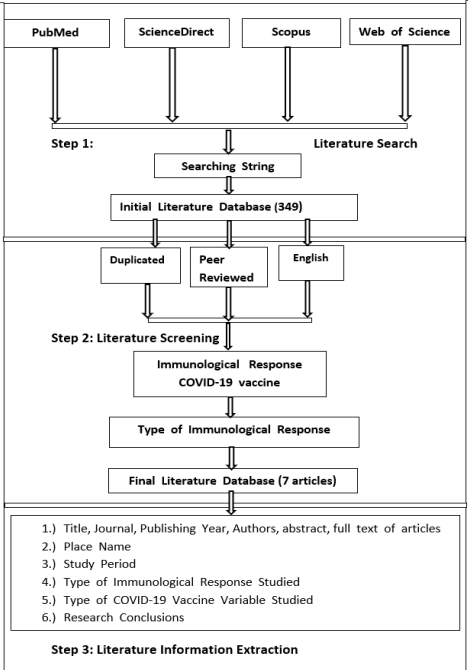
A comprehensive search was carried out in mainstream bibliographic databases or Medical Subject Headings, including ScienDirect, PubMed, Scopus, and ISI Web of Science. The search was applied to the articles that were published between 2021 and mid-2023, following the PRISMA 2020 Guideline. Our first involved performing searches of article abstract/keywords/title using strings of [(Kidney Transplantation” or “Kidney Transplant Recipient”, “SARS-CoV-2 ” or “ COVID-19 ” and “ Vaccine ” or “ Vaccination”, “Humoral Immunity ” or “ Humoral Immune ” or “ Humoral Immune Response ”, “ Immunosuppressants” or “ Immunosuppressive Regimens ”, “ Dialysis ”)]. After a first approach of search, published articles focusing on kidney transplantation were retained and the information on immunological response type and COVID-19 vaccination was extracted for having a crude knowledge involving their themes. Another round of publication search was conducted for adding the missing published articles that were not identified by the first round.
All keywords combinations from one immunological response type and immunosuppressive regimen variable to bind the population of cases under consideration. Search string for COVID-19-vaccine-type groups include [“Recombinant Subunit Vaccines ” or “ Protein Subunit Vaccine ” or “ Virus-like Particle (VLP) Vaccine ” or “ Nucleic Acid Vaccines ” or “ DNA-based Vaccines ” or “ RNA-based Vaccines ” or “Viral Vector Vaccines ” or “ Non-replicating Viral Vector Vaccines ” or “ Replicating Viral Vector Vaccines ” or “ Whole Virus Vaccines ” or “ Inactivated Vaccines ” or “ Live-attenuated Vaccines ” ]. The initial literature databases were further manually screened with the following rules : 1) non-kidney-transplanted-recipient-related articles were excluded; 2) articles that did not report a human-humoral-immunological-response or human-immunological-response related to COVID-19 vaccination were not considered, such as commentary articles, or editorial; 3) non-peer reviewed articles were not considered to be of a scholarly trustworthy validity; and 4) duplicated and non-English articles were removed. The articles were carefully selected to guarantee the literature quality, which is a trade-off for quantity.
With strict literature search and screening processes, it yielded 7 articles from 349 articles of initial literature database. Needed article information was extracted from each article by : 1) direct information including journal, title, authors, abstract, full text documents of candidate studies, publishing year; 2) place name of the study area; 3) study period; 4) research method used; 5) type of kidney-transplantation-immunological- response variables studied; 6) types of COVID-19 vaccine studied; and 7) the conclusions made about the impacts of related- humoral-immunological-response on kidney-transplanted recipients. An overview of the information required for the present analysis that was captured by those themes was shown in the Figure 1.
Table 1: Demonstrating the cellular and humoral immune response after COVID-19 vaccination in kidney transplant recipients (2021-to mid-2023)
Discussion
All seven related-published articles (100 %) from 349 published articles of the initial databases demonstrated positive humoral immune responses (serum anti-S1 IgA and IgG levels) among the KTRs after booster doses of mRNA-COVID-19 vaccination, particularly the elderly [21] (Table 1) [1, 11, 18-22], whereas serum TTV loads is a indicator of cellular and humoral immune responses and EVR increased immune responses, compared to MMF [21] after mRNA-COVID-19 vaccination among KTRs [19]. Both dialysis patients and KTRs demonstrated RBD+-B cell (pre-switch-B and nai?ve-B cells) enrichment [1]. Mycophinolic acid (MPA) withdrawal prior mRNA-COVID-19 vaccination in KTRs demonstrated critical rising of serum anti-S1- and anti-S2-IgG levels, including post-booster vaccination, in comparison to those who remained on MPA maintenance treatment [20]. One of the seven related-published positive articles revealed humoral immune responses above 5 BAU/mL at 33 days after the 5th booster dose of mRNA-COVID-19 vaccination [11]. KTR survivors with age above 70 years who received a living-donor organ demonstrated lower-COVID-19-risk-related death, compared to KTRs with an-organ-receiving from deceased donor, in addition to higher risk of COVID-19 infection among female KTRs [11]. Interestingly, a recent study demonstrated that viral-vector, and heterogenous of all homogenous mRNA-COVID-19 vaccines revealed reduction of levels of anti-S1 IgG between the first and third serum samples [18]. No differences between serum anti-S1 IgG levels at one and six-months after mRNA-COVID-19 vaccination in KTRs with one-month-post-mRNA-COVID-19-vaccination-IgG-immune-response seropositivity and different factors through linear regression analysis [18]. Among the immunocompromised population, including KTRs, DPs, PDs, at least three doses of mRNA-COVID-19 vaccination was recommended to be the preparation of choice [20, 22].
Conclusion
Withdrawal of the immunosuppressants in KTRs and immunocompromised individuals prior COVID-19 vaccination and at least third dose of mRNA-COVID-19 vaccination should be performed.
References
DOI : https://doi.org/10.1126/sciimmunol.abj1031
DOI : https://doi.org/10.1016/j.lanepe.2021.100178
DOI : https://doi.org/10.1001/jamaetworkopen.2021.31749
DOI : https://doi.org/10.1016/j.ebiom.2021.103524
DOI : https://doi.org/10.1093/ndt/gfab324
6. Mulley WR, Le ST, Ives KE. Primary seroresponses to double-dose compared with standard-dose hepatitis B vaccination in patients with chronic kidney disease : a systematic review and meta-analysis. Nephrol Dial Transplant 2017; 32 : 136-143.
7. Liao Z, Xu X, Liang Y, Xiong Y, Chen R, Ni J. Effect of a booster dose of influenza vaccine in patients with hemodialysis, peritoneal dialysis and renal transplant recipients : a systematic literature review and meta-analysis. Hum Vaccin Immunother 2016; 12 : 2909-2915.
8. Syed-Ahmed M, Narayanan M. Immune dysfunction and risk of infection in chronic kidney disease. Adv Chronic Kidney Dis 2019; 26 : 8-15.
9. Kato S, Chmielewski M, Honda H, Pecoits-Filho R, Matsuo S, Yusawa Y, et al. Aspects of immune dysfunction in end-stage renal disease. Clin J Am Soc Nephrol 2008; 3 : 1526-1533.
10. Betjes MGH. Immune cell dysfunction and inflammation in end-stage renal disease. Nat Rev Nephrol 2013; 9 : 255-265.
DOI : https://doi.org/10.1016/j.eclinm.2023.102035
12. Nimmo A, Gardiner D, Ushiro-Lumb I, Ravanan R, Forsythe JLR. The global impact of COVID-19 on solid organ transplantation : two years into a pandemic. Transplantation 2022; 106 (7) : 1312-1329.
13. Midtvedt K, Vaag JT, Heldal K, Munthe LA, Lund-Johansen F, Asberg A. Fourth dose of the SARS-CoV-2 vaccine in kidney transplant recipients with previously impaired humoral antibody response. Am J Transplant 2022; 22 (11) : 2704-2706.
14. Kamar N, Abravanel F, Marion O, et al. Assessment of 4 doses of SARS-CoV-2 messenger RNA-based vaccine in recipients of a solid organ transplant. JAMA Netw Open 2021; 4 (11) : e2136030.
15. Boyarski BJ, Bar5bur I, Chiang TP, et al. SARS-CoV-2 messenger RNA vaccine immunogenicity in solid organ transplant recipients with prior COVID-19. Transplantation 2021; 105 (11) : e270-e271.
16. Hall VG, Ferreira VH, Ku T, et al. Randomized trial of a third dose of mRNA-1273 vaccine in transplant recipients. N Engl J Med 2021; 385 (13) : 1244-1246.
17. Sakuraba A, Luna A, Micic D. A systematic review and meta-analysis of serologic response following coronavirus disease 2019 (COVID-19) vaccination in solid organ transplant recipients. Viruses 2022; 14 (8) : 1822.
DOI : 10.3390/v14081822
18. Mahallawi WH, Alharbi WA, Aloufi SA, Ibrahim NA, Abdelrahman MM, Alhomayeed BA, et al. Decline humoral immunity of kidney transplant recipients to SARS-CoV-2 vaccines. Infection and Drug Resistance 2023; 16 : 2829-2840.
DOI : https://doi.org/10.2147/IDR.S408686
19. Graninger M, Stumpf J, Bond G, Go?rzer I, Springer DN, Kessel F, et al. Prediction of humoral and cellular immune response to COVID-19 mRNA vaccination by TTV load in kidney transplant recipients and hemodialysis patients. Journal of Clinical Virology 2023; 162 : 105428.
DOI : https://doi.org/10.1016/j.jcv.2023.105428
20. Benning L, Morath C, Ku?hn T, Bartenschlager M, Kim H, Beimler J, et al. Humoral response to SARS-CoV-2 mRNA vaccination in previous non-responder kidney transplant recipients after short-term withdrawal of mycophenolic acid. Frontiers in Medicine 2022. Published online : August 18, 2022.
DOI : 10.3389/fmed.2022.958293
21. de Boer SE, Berger SP, van Leer-Buter CC, Kroesen B-J, van Baarle D, Sanders F J-S. Enhanced humoral immune response after COVID-19 vaccination in elderly kidney transplant recipients on everonimus versus mycophenolate mofetil-containing immunosuppressive regimens. Transplantation 2022; 106 (8) : 1615-1621.
DOI : 10.1097/TP.0000000000004177