Mucoepidermoid Carcinoma in a Young Individual: A Case Report and Review
Mucoepidermoid Carcinoma in a Young Individual: A Case Report and Review
Dr Ishani Thakkar 1, Dr Shehnaz Kantharia 2, Dr Rajesh Kantharia* 3
1. Fellow in Head and Neck Oncosurgery, Kailash Cancer Hospital, Goraj
2. ENT and Head and Neck Surgeon, Head and Neck Oncosurgery, Kailash Cancer Hospital, Goraj
3. Head of Department, Head and Neck Oncosurgery, Kailash Cancer Hospital, Muni Seva Ashram, Goraj.
*Correspondence to: Dr Rajesh Kantharia, Head of Department, Head and Neck Oncosurgery, Kailash Cancer Hospital, Muni Seva Ashram, Goraj.
Copyright
© 2023 Dr Rajesh Kantharia. This is an open access article distributed under the Creative Commons Attribution License, which permits unrestricted use, distribution, and reproduction in any medium, provided the original work is properly cited.
Received: 27 October 2023
Published: 03 November 2023
Abstract
Mucoepidermoid carcinoma is the most common malignant tumour. Due to its rare occurrence in young children and adults, there are less cases reported in literature. In this paper we have outlined a case of young individual who presented with a painless swelling of parotid region with fungation of overlying skin. Fine needle biopsy was suggestive of mucoepidermoid carcinoma of parotid gland. Superficial parotidectomy was performed, consequently marginal mandibular nerve was sacrificed alluding to the remarkable surgical challenge. Postoperative recovery was uneventful. With the thorough review of literature, discussion on prevalence,origin, type and mode of treatment is made.
Keywords: mucoepidermoid, parotid, young patients
Mucoepidermoid Carcinoma in a Young Individual: A Case Report and Review
Introduction
Salivary gland malignancies represent 5% of head and neck malignancies.[1] Amongst it,1% of all cancers are salivary gland neoplasm in general population, whereas 5% of them occurring amongst children <20% of age. [2] Parotid gland tumors account for 80% of benign neoplasm whereas majority of malignant tumors are common in minor salivary gland. The neoplasms in salivary gland are rare in pediatric and adult population with variable diversity clinically and histologically.[2] The most common malignant carcinoma is mucoepidermoid carcinoma with strong predilection for parotid gland.[3] It usually presents as asymptomatic mass with prominent cystic component. Hereby, we elucidate an interesting case which being rare in terms of its age and clinical presentation.
Case Presentation
A patient of 16-years-old male presented to ENT and Head and NECK OPD at Kailash Cancer Centre with complaint of right side facial swelling since 1.5 years. Previously patient was taking treatment at primary healthcare centre in rural area. Patient’s relatives noticed no change in symptoms but rather increased in size of the right-side face swelling.
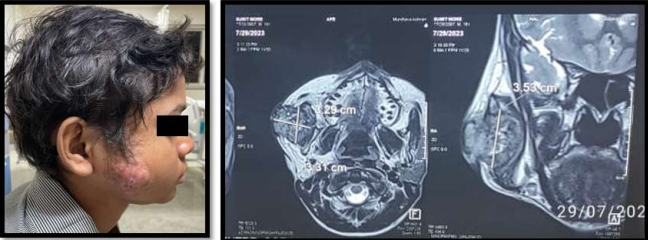
On examination right side extraoral swelling measuring approximately 4*3cm over right pre auricular & parotid region. Overlying skin with impending fungation and fixed with underlying structure. The swelling was extending supero inferiorly from zygomatic arch up to inferior border of mandible, antero posteriorly from zygomatic buttress to posterior border of mandible. Ear lobe was not raised. His facial nerve functions were normal. No neck nodes palpable. External auditory canal and tympanic membrane was normal.
On intraoral examination, there was no soft tissue bulge in oropharynx and mouth opening was restricted due to pain. Cheek biting was noted. Not associated with pain or dysphagia.
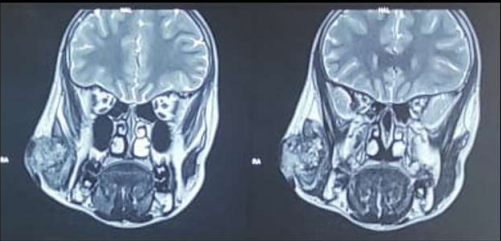
Patient was advised USG guided Fine Needle Biopsy (FNB) and MRI for right parotid swelling. FNB was suggestive of mucoepidermoid carcinoma. MRI showed lobulated mass involving right parotid region of size 3*3.4*4.7cm (AP*TRA*CC), right masseter muscle was involved. Laterally overlying skin and cutaneous tissues were involved, medially abutting right mandibular ramus. Diffuse fatty infiltration of right parotid gland with involvement of superficial lobe of parotid gland. Deep lobe and neurovascular bundle were unremarkable.
On presurgical evaluation and routine investigations he was diagnosed with raised APPT (Activated Partial Thromboplastin Clotting Time) and Wolff Parkinson White (WPW) syndrome. Coagulation factor assay and mixing study was carried out and factor XII deficiency was found. Hematology and cardiac references were done respectively and no active treatment was advised. So, we had planned for right superficial parotidectomy and reconstruction with Anterolateral thigh flap.
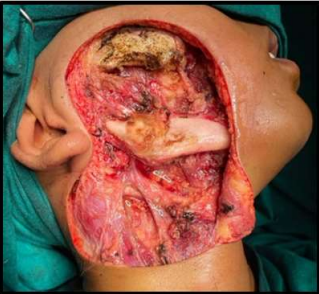
Surgical intervention included wide local excision of tumor with involved overlying skin & superficial parotidectomy. Right level II neck node was sent for frozen section to decide for elective neck dissection. In our case, main trunk of facial nerve was not involved and was spared, marginal and cervical branch were sacrificed due to tumor proximity. Intraoperatively meticulous dissection was performed, proximal cut end of facial nerve was sent for frozen section to rule out disease free margin of nerve. Both node and facial nerve cut end were free of tumor on frozen section. Later, the defect coverage was done with Anterolateral thigh flap. Post operative course was uneventful.
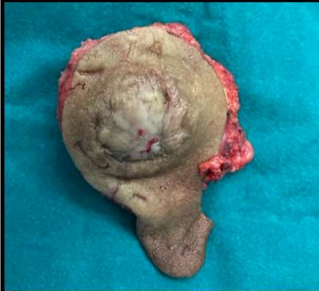
Histopathological examination revealed low grade mucoepidermoid carcinoma of right parotid gland with maximum tumor dimension 4.4cm, involving dermis of overlying skin and adjoining skeletal muscle. Perineural and lymphovascular invasion was present. The final pathological staging was pT4aN0M0. Patient was therefore referred for adjuvant radiotherapy.
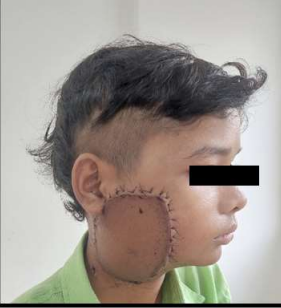
Figure 1: PREOPERATIVE
Figure 2
Figure 3: Intraoperative bed after superficial parotidectomy
Figure 4: SPECIMEN
Figure 5: POSTOPERATIVE
Discussion
Salivary tumors are uncommon in both pediatric and adult population.[4] Salivary gland neoplasms comprise of 8% in pediatric population in head and neck malignancies [4]. In the cohort study conducted by Asad et al. 3.7% comprised of pediatric population while 96.3% were adults, where patients <18 years were categorized as pediatric population. [4] The World Cancer Report 2014 had to include adolescents and young adults to present the data on salivary gland neoplasm under childhood malignancies.[5] The incidence of malignant salivary neoplasm in children is not available in India & even in adults, they are not among the first 20 most common cancers in any of the Indian cancer registries [6].
The most common malignant salivary gland tumor is mucoepidermoid carcinoma and commonly affects parotid and minor salivary glands [7]. Most common site for benign and malignant salivary gland neoplasm is parotid gland, followed by minor salivary glands in oral cavity, submandibular gland and rarely sublingual salivary gland [4].
Mucoepidermoid carcinoma usually is more common in adults, with slight female preponderance [7]. Few studies have reported worse prognosis of MEC in male patients [8,9,10], whereas gender distribution is ill defined in pediatric population [11].
Clinically, MEC generally present as slow growing painless mass below ear lobule. Mainly pain and/or facial nerve palsy is associated with high grade tumors. In our case, overlying skin was involved with fungation (photo 1) and such presentation is rare.
WPW syndrome is a congenital cardiac condition arising from abnormal cardiac electrical conduction. Asymptomatic patients usually don’t require any immediate treatment. In the case described above, patient was asymptomatic and it was an accidental finding during routine examination as a part of preoperative evaluation for surgery.
Mucoepidermoid carcinoma is histologically classified into three grades: low grade, intermediate and high grade, with more common low grade (48%) than high grade (38.7%).[7] These histological grades are based on degree of cytological atypia, amount of cyst formation & relative numbers of mucous, epidermoid and intermediate cells [12]. Histological grade and tumor stage has strong correlation with prognosis as already proven in prior research [13]. The overall disease free 5 years survival as reported by Liu.et.al, was 80.7%, with 98% for low grade,86.5% for intermediate and 38.5% for high grade tumors respectively [14]. Similarly, cause specific and demographic distribution of mucoepidermoid carcinoma was analyzed by Ali et al. and Chen et al. wherein disease specific survival rate was lower in high grade MEC than other grades [15,16]. The literature also shows favorable outcomes in pediatric population.
Surgical resection is the mainstay treatment. It is supplemented with adjuvant radiotherapy in advanced tumors to prevent locoregional recurrence. The outcome of patients with localized MEC who underwent surgery and radiation were investigated in a study by Chen et al. They have noted high treatment failure rates in locally advanced and high grade tumors [17]. Also found that higher the tumor grade, more metastatic potential tumor had. This therefore necessitates the need to explore systemic therapy. In our case due to higher stage, perineural invasion patient was referred for adjuvant radiotherapy.
The incidence of lymph nodes metastases in primary salivary gland neoplasm ranges between 11 and 37%, however in advanced and high grade tumors, it is up to 50%. [18,19,5] but in view of cosmetic and functional deficit associated with neck dissection especially among children and adolescents, we have opted for limited lymph node sampling and frozen section, to rule out the need for neck dissection.
Conclusion
Thus, to conclude, the occurrence of salivary gland malignancy is rare especially in age group <18 years. Mainly factors like age, tumor grade & tumor size>2cm affects the disease prognosis and treatment outcomes & decide the need for adjuvant treatment. The outcome in children is usually better when approached surgically.
Reference
1. Peraza, A., Gómez, R., Beltran, J. and Amarista, F.J., 2020. Mucoepidermoid carcinoma. An update and review of the literature. Journal of stomatology, oral and maxillofacial surgery, 121(6), pp.713-720.
2.Ullah, A., Khan, J., Waheed, A., Karki, N.R., Goodbee, M., Yasinzai, A.Q.K., Tareen, B., Wali, A., Khan, K.A., Zarak, M.S. and Khan, I., 2022. Mucoepidermoid Carcinoma of the Salivary Gland: Demographics and Comparative Analysis in US Children and Adults with Future Perspective of Management. Cancers, 15(1), p.250.
3.Boahene, D.K.O., Olsen, K.D., Lewis, J.E., Pinheiro, A.D., Pankratz, V.S. and Bagniewski, S.M., 2004. Mucoepidermoid carcinoma of the parotid gland: the Mayo clinic experience. Archives of Otolaryngology–Head & Neck Surgery, 130(7), pp.849-856.
4.Ullah, A., Khan, J., Waheed, A., Karki, N. R., Goodbee, M., Yasinzai, A. Q. K., ... & Heneidi, S. (2022). Mucoepidermoid Carcinoma of the Salivary Gland: Demographics and Comparative Analysis in US Children and Adults with Future Perspective of Management. Cancers, 15(1), 250.
5.Qureshi, S. S., Bhagat, M., Singhal, N., Tathe, N., Kembhavi, S., Laskar, S., ... & Yadav, P. (2016). Clinical characteristics and treatment outcomes of primary and recurrent malignancy involving the salivary glands in children. Head & Neck, 38(6), 852-856.
6.Curado, M. P., Edwards, B., Shin, H. R., Storm, H., Ferlay, J., Heanue, M., & Boyle, P. (2007). Cancer incidence in five continents, Volume IX. IARC Press, International Agency for Research on Cancer.
7.Devaraju, R., Gantala, R., Aitha, H., & Gotoor, S. G. (2014). Mucoepidermoid carcinoma. Case Reports, 2014, bcr2013202776.
8.Yoshida, E. J., García, J., Eisele, D. W., & Chen, A. M. (2014). Salivary gland malignancies in children. International journal of pediatric otorhinolaryngology, 78(2), 174-178.
9.Boukheris, H., Curtis, R. E., Land, C. E., & Dores, G. M. (2009). Incidence of carcinoma of the major salivary glands according to the WHO classification, 1992 to 2006: a population-based study in the United States. Cancer epidemiology, biomarkers & prevention, 18(11), 2899-2906.
10.Sirohi, D., Sharma, R., Sinha, R., & Suresh Menon, P. (2009). Salivary gland neoplasms: an analysis of 74 cases. Journal of maxillofacial and oral surgery, 8, 164-166.
11.Kupferman, M. E., de la Garza, G. O., Santillan, A. A., Williams, M. D., Varghese, B. T., Huh, W., ... & Weber, R. S. (2010). Outcomes of pediatric patients with malignancies of the major salivary glands. Annals of surgical oncology, 17, 3301-3307.
12.Rajendran, R. (2009). Shafer's textbook of oral pathology. Elsevier India.
13.Byrd, S. A., Spector, M. E., Carey, T. E., Bradford, C. R., & McHugh, J. B. (2013). Predictors of recurrence and survival for head and neck mucoepidermoid carcinoma. Otolaryngology--Head and Neck Surgery, 149(3), 402-408.
14.Li, C. Z., Sun, M. Y., Zhang, X. H., Luo, X. L., & Sun, W. B. (2006). Analysis of postoperative survival rates of mucoepidermoid carcinoma in salivary gland. Zhonghua kou Qiang yi xue za zhi= Zhonghua Kouqiang Yixue Zazhi= Chinese Journal of Stomatology, 41(12), 709-712.
15.Ali, S., Sarhan, M., Palmer, F. L., Whitcher, M., Shah, J. P., Patel, S. G., & Ganly, I. (2013). Cause-specific mortality in patients with mucoepidermoid carcinoma of the major salivary glands. Annals of surgical oncology, 20, 2396-2404.
16.Chen, M. M., Roman, S. A., Sosa, J. A., & Judson, B. L. (2014). Histologic grade as prognostic indicator for mucoepidermoid carcinoma: a population?level analysis of 2400 patients. Head & neck, 36(2), 158-163.
17.Chen, A.M.; Lau, V.H.; Farwell, D.G.; Luu, Q.; Donald, P.J. Mucoepidermoid carcinoma of the parotid gland treated by surgery and postoperative radiation therapy: Clinicopathologic correlates of outcome. Laryngoscope 2013, 123, 3049–3055.
18.Sultan, I., Rodriguez–Galindo, C., Al?Sharabati, S., Guzzo, M., Casanova, M., & Ferrari, A. (2011). Salivary gland carcinomas in children and adolescents: a population?based study, with comparison to adult cases. Head & neck, 33(10), 1476-1481.
19.Thariat, J., Vedrine, P. O., Temam, S., Ali, A. M., Orbach, D., Odin, G., ... & Castillo, L. (2013). The role of radiation therapy in pediatric mucoepidermoid carcinomas of the salivary glands. The Journal of pediatrics, 162(4), 839-843.