Healing the Gap: Endoscopic Management of a Sick Patient with Empyema due to Unusual Cause of Esophago-Pleural Fistula.
Healing the Gap: Endoscopic Management of a Sick Patient with Empyema due to Unusual Cause of Esophago-Pleural Fistula.
Dr. D. Viswanath Reddy*1, Dr. Sai Reddy Y.2, Dr. Nagaraju2, Dr. Vijayalakshmi3
1. Department of Gastroenterology, Yashoda Hospital, Secunderabad, India.
2. Department of Pulmonology, Yashoda Hospital, Secunderabad, India.
3. Department of Critical care Medicine, Yashoda Hospital, Secunderabad, India.
*Correspondence to: Dr. D. Viswanath Reddy, Department of Gastroenterology, Yashoda Hospital, Secunderabad, India.
Copyright
© 2024 Dr. D. Viswanath Reddy. This is an open access article distributed under the Creative Commons Attribution License, which permits unrestricted use, distribution, and reproduction in any medium, provided the original work is properly cited.
Received: 18 April 2024
Published: 01 May 2024
Abstract
Introduction: Esophago-pleural fistula(EPF) is an uncommon condition wherein there is an abnormal communication between oesophagus and pleural cavity. It can lead to fatal Mediastinitis and Empyema with sepsis. Surgery and conservative management are the options. We hereby describe an unusual cause of EPF due to accidental removal of Nasogastric tube in a patient with recent cerebrovascular stroke, developed sepsis was managed appropriately with closure by endoscopic procedures.
Methods: 52 year old female who had recent ischaemic stroke, being managed in Rehabilitation unit presented with sudden onset of breathlessness and sepsis. Evaluation was suggestive of bilateral Empyema. Bilateral Intercostal drains(ICD) were placed and broad spectrum antibiotics were given. CT chest showed bilateral pleural effusions. Bronchoscopy was non-contributory. Clinical suspicion of Esophageal rupture was made in view of history of accidental removal of Nasogastric tube preceding the catastrophic illness. Endoscopy showed a large defect(3cm) in lower Esophagus with pus draining. Options of surgery and conservative management was discussed with relatives. Due to her poor general condition and recent stroke, conservative management was considered. Oesophageal defect was closed using multiple large Endoclips(10). Percutaneous Gastrostomy(PEG) was placed and through it, a feeding tube was placed into duodenum over guide wire under endoscopic guidance all at bedside in ICU. She showed gradual improvement in terms of response to sepsis, ICDs were removed and she tolerated PEG-D feeds. Three months later she was reviewed, Contrast study showed closure of EPF fistula and Endoscopy showed a pseudodiverticulum in the area. She was then started on oral diet and subsequently PEG-D tube was removed. Follow up in outpatient department was gratifying in terms of clinical response.
Results: We describe a case of EPF with Empyema due to rare cause of traumatic Nasogastric tube removal. Diagnosis is challenging in critically ill patients, strong index of suspicion of fistula(EPF)is to be considered in case of persistent drains. She was managed successfully with antibiotics, ICD placement, Endoscopic intervention by clip closure and providing an alternative feeding tube option.
Conclusion: Esophago-pleural fistula due to accidental removal of Nasogastric tube is rarely described. Empyema management and Endoscopic therapy of the large defect with addition of alternative nutritional route helps enhancing healing of the fistula.
Key words: Esophago-pleural fistula, Nasogastric removal, Empyema, endoscopic clip closure, PEG-J
Healing the Gap: Endoscopic Management of a Sick Patient with Empyema due to Unusual Cause of Esophago-Pleural Fistula.
Case Details
A 52 year old female with neurogenic dysphagia due to cerebrovascular accident was admitted to the rehabilitation unit and was given nasogastric feeds. The Nasogastric tube got blocked and in the process of removal, there was a resistance felt. Next day, she developed shortness of breath and high grade fever and was referred to our centre for further management in view of sepsis with oxygen requirement. She was admitted in pulmonology unit with respiratory failure and hence was intubated and connected to ventilator. Chest X ray showed pleural effusion for which therapeutic thoracocentesis was done, Intercostal drains were placed on both sides. The pleural fluid on analysis was suggestive of Empyema. Fluid cultures were taken and Antibiotic was hiked up. CT chest showed bilateral pleural effusions and did not show any fistula.
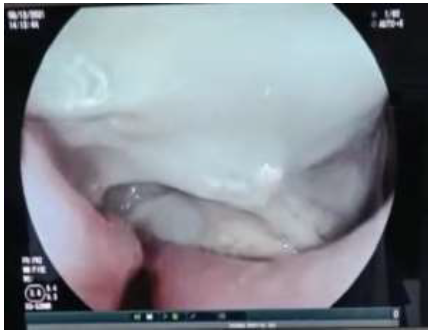
She continued to have persistent draining pleural fluid and hence a suspicion of any fistula was considered. Bronchoscopy was normal. Endoscopy showed a large rent (3cm) in distal third Esophagus with pus draining from the opening.
Thoracic Surgeon consultation was taken and the patient was given the option of surgery with very high risk in view of a recent stroke. Patient was given the option of PEG feeding which they agreed. They were also explained about the option of covered metallic stenting and a possibility of closing the rent using endoscopic large clips.
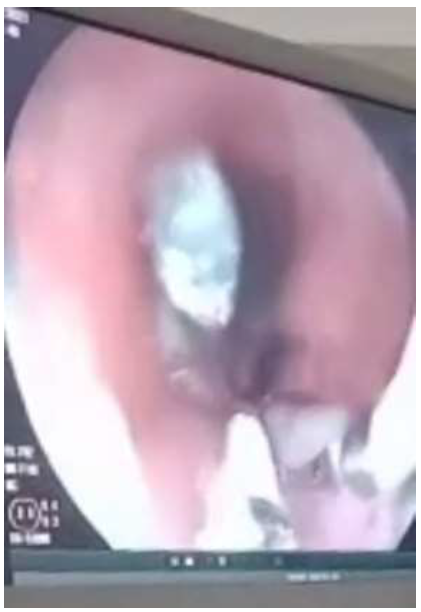
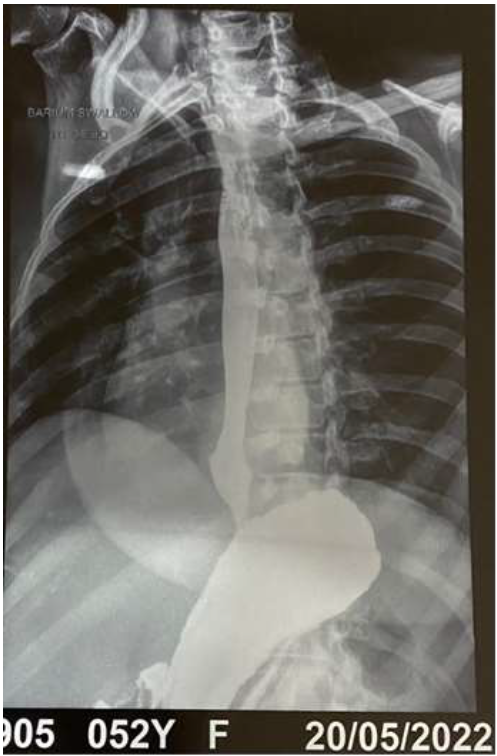
With a valid consent Endoscopic PEG tube placement was done. Through the PEG tube, Freka nasojejunal tube was placed into duodenum-literally PEG-D. Then the fistula rent was closed using 10 Large Haemostatic Clips. The mucosal defect appeared approximated. The patient improved over next few days, ICD’s were removed, extubated from ventilator support and oxygen requirement came down and slowly was shifted back to rehabilitation on PEG feeds and on antibiotics. Six weeks later, small beak like contained leak was noted in distal third portion on Gastrograffin swallow. She was continued on PEG feeds and on follow up at the end of 3 months, contrast swallow showed no leak and there was a pseudodiverticulum appearance on check Endoscopy. She was then initiated on oral feeds and PEG tube was removed. She did well on subsequent follow up a month later.
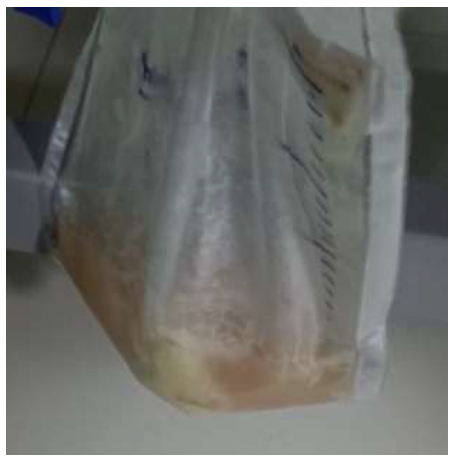
Figure-1: Empyema-Pus from ICD tube with bubbles
Figure-2 :Esophageal defect
Figure-3: Post clipping
Figure-4: Contrast swallow- no leak
Discussion
Management of a sick patient with Esophago-pleural fistula is difficult. Our index patient is unique in several aspects of presentation. Firstly, she developed Esophago-pleural fistula due to a a very rare cause-iatrogenic traumatic pulling of a coiled nasogastric tube. It is probably not reported till now in literature. Secondly, CT scan showed bilateral pleural effusion but had not picked up the fistula. Thirdly, the diagnosis was made on Endoscopy as it was suspected to be a fistula in view of persistent pleural drainage.
The surgical approach to closing the fistula was difficult in this patient due to her comorbid illness. Endoscopic approach to closure is generally not feasible as it was a large defect (3cm) and 10 days old rent with active pus discharging.
We initially considered feeding option of Percutaneous Endoscopic Gastrostomy-Jejunostomy and covered Oesophageal Metal stenting, for spontaneous closure. But the option of Endoscopic clip closure was considered in the last moment (based on our experience with closure of POEM mucosotomy) and it worked well for the patient. She improved dramatically and the fistula got closed over next few weeks.
Healing power of our body is so obvious in this case. Draining the collection, active management of the sepsis, approximating the defect, providing diversion for feeding are the main principles in successfully managing this difficult to manage case.
Conclusion
Esophago-pleural fistula due to accidental removal of Nasogastric tube is rarely described. It is challenging to manage a sick patient. Empyema management and Endoscopic therapy of the large defect with providing alternative nutritional route helps enhancing healing of the fistula.
References
1. Management of esophago-pleural fistula, S. Schaefer and J.G. hunter, The Annals of Thoracic Surgery
2. Management of esophago-pleural fistula: a review of literature, A leers et al, Diseases of the Esophagus
3. Surgical management of esophago-pleural fistula: a systemic review of techniques and outcomes, L.M. Fischer et al, The American Journal of Surgery
4. Endoscopic management of esophago-pleural fistula: a systematic review, A.R. Alai et al, World Journal of Gastrointestinal Endoscopy
5. Esophago-pleural fistula: A comprehensive review of its clinical presentation, diagnosis, management and outcomes, F.K. Halal et al, American Journal of Gastroenterology
6.Endoscopic management of esophago-pleural fistula, H.S. Park et al, Gastrointestinal Endoscopy Clinics of North America
7. Esophago-pleural fistula: a diagnostic and therapeutic challenge, P.K. Pattnaik et al, Journal of Gastrointestinal Surgery
8.Treatment of esophago-pleural fistula, A.L. Semenkovich, J.B. Lipham et al, Thoracic Surgery Clinics
9.The role of Endoscopic stents in the management of esophago-pleural fistula, A.K. Mishra et al, Annals of Gastroenterology
10. Management of esophago-pleural fistula using an expandable metallic stent, Y.K. Kim et al, Diseases of the Esophagus.
11. Esophago-pleural Fistula: Management and outcome, G. Agarwal et al, Journal of clinical and Experimental Hepatology
12.Role of covered self Expanding metallic stents in the management of benign Oesophageal disorders, V. Gupta et al, Indian Journal of Gastroenterology
13. Role of Endoscopic Stenting in the management of esophago-pleural fistula, P.B. Desai et al, Journal of Digestive Endoscopy
14.Management of Esophago-pleural fistula-Our experience, S.K. Sinha et al, Journal of Digestive Endoscopy
15. Surgical management of Esophago-pleural fistula: A single centre experience, A.K. Singh et al, Indian Journal of Thoracic and Cardiovascular Surgery.