Parotid Sialolithiasis and Sialadenitis: A Case Report

Parotid Sialolithiasis and Sialadenitis: A Case Report

Jasly K*1

*Correspondence to: Jasly K

Copyright

© 2024 Jasly K. This is an open access article distributed under the Creative Commons Attribution License, which permits unrestricted use, distribution, and reproduction in any medium, provided the original work is properly cited.

Received: 19 August 2023

Published: 01 January 2024


Parotid Sialolithiasis and Sialadenitis: A Case Report

Introduction

Sialolithiasis is an obstructive disorder of salivary ductal system caused by formation of stones within the salivary gland or its excretory duct (1). The resulting salivary flow obstruction leads to salivary ectasia, gland dilatation and ascending infection (2). The clinical symptoms are clear and allow for an easy diagnosis, whenever we take into account that pain is only one of the symptoms and that it does not occur in 17% of the cases (3). Sialolithiasis accounts for 30% of salivary diseases and it most commonly involves the submaxillary glands (83 to 94%) and less frequently the parotid (4 to 10%) and sublingual glands (1 to 7%).

Several hypotheses have been put forward to explain the etiology of calculi: mechanical, inflammatory, chemical, neurogenic, infectious, foreign bodies, etc. It seems that the combination of a variety of these factors usually provokes the precipitation of the amorphous tricalcium phosphate, which, once crystallized and transformed into hydroxyapatite becomes the initial focus. From this moment on, it acts as a catalyst that attracts and supports the proliferation of new deposits of different substances (3). Salivary calculi affecting the parotid gland are usually unilateral and are located in the duct. Their size is smaller than submaxillary sialoliths, most of them < 1 cm. (4,5). It may occur at all ages, but there is a peak incidence in the 4th, 5th and 6th decades.

Obstruction of salivary secretion by a sialolith can result in swelling and pain, as well as infection of the gland the swelling is usually correlated to meals, when salivary secretion is enhanced (6).


Case Report

A 45year-old female patient was presented with complaining of painful swelling in the right parotid area and low-grade fever. She had no major medical problem and was not taking any medication. Upon inspection, parotid area appeared swollen and erythematic. Oral examination revealed swelling at the right buccal mucosa. A hard, well-defined mass was palpable in the anterior portion of the Stenson's duct. A small amount of exudate was discharged from the orifice.

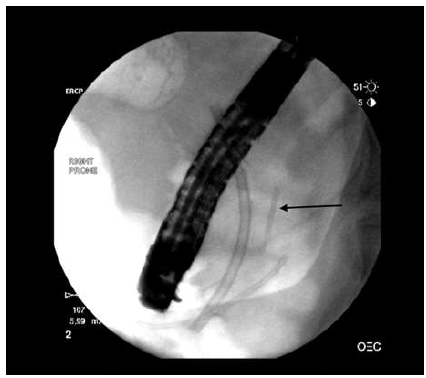
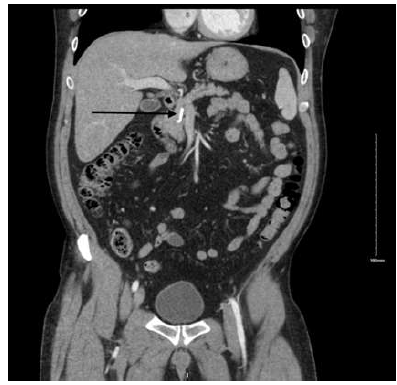
A panoramic radiograph revealed a small radiopaque area at the clinically palpated mass, consistent with the diagnosis of sialolithiasis in Stenson's duct of the right parotid gland. Ultrasonography (USG) of the right side of the face shows radiopaque substance in the region of the right Stensen’s duct.


Differential Diagnosis

Differential diagnosis included viral sialadenitis-mumps, acute bacterial sialadenitis, radiation sialadenitis and Sjogren’s disease, which were ruled out during clinical, radiological and histopathological examination.


Treatment

Surgical exploration was done under local anaesthesia. Stone was palpated near ductal orifice. stone measuring about 6 mm in length was visible at the orifice, which was retrieved (figure1). A stent was placed in the right Stensen’s duct (figure 2) to maintain the patency of the duct and milking of gland was done to check the free flow of saliva (figure 3). Closure was done with 3-0 vicryl (figure 5).
The calculi had irregular borders and a yellowish color with 6*3 mm (figure 4).


The patient was kept on parenteral antibiotics for 2 days and switched to an oral alternative when discharged from the hospital. On one week follow-up, the swelling was almost normalized without any further problems and the patient was prescribed 5 additional days of oral antibiotics.


Discussion

Parotid calculi are considered rare as compared to those of the submandibular gland both in children and adults (Horie et al., 1995) (7).The higher incidence of sialolithiasis as the patients grow older (Lustman et al, 1990) can be due to reduced secretory activity, alterations of electrolyte concentrations and impairment of glycoprotein synthesis of the salivary glands; all of which could result from structural deterioration of cell membranes during aging (Bodner and Gorsky, 1996)(8). Zenk et al. (9) found that only 6.1% of 635 patients with sialolithiasis were younger than 20 years and among these there were two cases of a solitary parotid gland stone in a 4-year-old girl and a 2-year old boy.

Several theories have been suggested as to the pathogenesis of sialolithiasis but none have yet been firmly established. The sialolith is assumed to be formed by the deposition of organic and inorganic materials around a central core. The central core is composed of the precipitation of calcium salts around an initial organic nidus that consists of altered salivary mucins, bacteria and desquamated epithelial cells. The organic layers are composed of various carbohydrates and amino acids and the inorganic layers consist of calcium phosphate, a small quantity of carbonates in the form of hydroxyapatite, and a small amount of magnesium and ammonia). Other factors that have been suggested were alkalinization of saliva, physical trauma, stagnation of saliva, gout and nephrolithiasis. The ratio of organic to inorganic material in a submandibular stone is 18:82, whereas that in a parotid stone is 51:49(10). Grossly, the sialolith has a round or ovoid shape, a porous texture and a pale-yellow color, measuring from 1 mm to less than 1 cm in general. Examples larger than 15 mm are considered giant calculi, of which only a handful of cases have been reported.

The presentation of parotid sialolithiasis varies in different stages. During acute infection phases, patient may present with pain, swelling, redness and discharge from the duct, which can be precipitated by meals. However, in the chronic phase, the patient may present with recurrent painful swelling or non-resolving infections of the gland which usually reduce in size. In our case, patient was symptomatic and shows signs of infection. Severe obstruction of the gland is shown by exquisite tenderness, intraoral and/or extraoral swelling and the absence of saliva on palpation. The differential diagnosis of salivary calculi includes infections (bacterial and viral), inflammatory conditions (Sjögren’s, sarcoidosis, radiotherapy reaction) and masses (neoplastic and nonneoplastic).

Diagnostic imaging to identify presumed salivary calculi include conventional radiography, sialography and USG. But currently, high-resolution non-contrast CT scanning is the imaging modality of choice for the evaluation of salivary stones. This is because many calcified sialoliths are not detected by conventional radiography until they are 60–70% calcified with at least 20% of submandibular and 50% of parotid stones not identifiable on intraoral and panoramic rradiography. We couldn’t perform CT scan as patient rejected to doing the same. USG shows radiopaque mass near duct. In sialography, a dye is injected into the duct, and it can demonstrate obstruction as a filling defect in the duct and duct stenosis. It cannot, however, demonstrate small secretion plugs or secretion plaques, and it is contraindicated in acute infection or in patients with a significant contrast allergy.

Small caliber endoscopy was developed to treat obstructive disorders of the salivary gland duct system. It is both diagnostic and therapeutic, and has the benefit of differentiating between obstructive inflammatory conditions and calculi. Despite most sialoliths being composed of calcium elements, they are not associated with systemic calcium abnormalities, so a serum calcium level is not mandatory.

Sialo endoscopy, fluoroscopy-guided wire basket extraction, lithotripsy and surgical removal are other options when expectant management fails or is inappropriate. The decision about which technique to utilize depends on stone size, location and procedure availability. The stone will stay in the gland until it is removed.

A conservative approach, including oral analgesia, hydration, local warm heat therapy, massage to ‘milk’ out the stone, sialagoguess to promote ductal secretions, and discontinuation of anticholinergic medications when possible are recommended. In most cases, removing the stone will relieve pain except when an associated infection exists.


Antibiotics covering oral flora for gland superinfection are recommended. Severe obstruction usually requires surgical intervention, especially when the obstruction is close to the gland. Our patientwas found to have a 7 mm right parotid stone that was surgically removed at the chair side using local anesthesia. She tolerated the procedure well and was discharged. The patient was asymptomatic after 1-year follow-up.


References

1.   Kim DH, Song WS, Kim YJ, Kim WD (2013) Parotid sialolithiasis in a two-year old boy. Korean J Pediatr 56(10):451–455. https://doi.org/10.3345/kjp.2013. 56.10.451

2.   Lustmann J, Regev E, Melamed Y. Sialolithiasis (1990). A survey on 245 patients and a review of the literature. Int J Oral Maxillofac Surg 19(3):135- 138. doi:https://doi.org/10.1016/s0901-5027(05)80127-4

3.   Bodner L. Parotid sialolithiasis. J Laryngol Otol 1999;113:266-7.

4. Seifert G, Miehlke A, Hanbrich J, Chilla R, eds. Diseases of the salivary glands: pathology, diagnosis, treatment, facial nerve surgery. Stuttgart:George Thime Verlag; 1986. p. 85-90.

5.   Ottaviani F, Galli A, Lucia MB, Ventura G. Bilateral parotid sialolithiasis

in a patient with acquired immunodeficiency syndrome and immunoglobulin G multiple myeloma. Oral Surg Oral Med Oral Pathol Oral Radiol Endod 1997;83:552-4.

6.   HARDY KJ. Submandibular calculous disease,Royal Melbourne Hospital, 1954- 1963. Med J Aust 1966: 16: 670-1.

7.   Horie, N., Shimoyama, T., Tane bayoshi, Y., Ide, F. (1995) Parotid sialolithiasis in a child. Journal of Clinical Pediatric Dentistry 20: 61-62.

8.   Bodner, L.Gorsky, M. (1996) Parotid gland secretion of the aging rat. Archives of Gerontology and Geriatrics 22: 63-69.

9.   Zenk J, Constantinidis J, Kydles S, Hornung J, Iro H. Clinical and diagnostic findings of sialolithiasis. HNO 1999;47:963-9.

antarmuka fokus mahjong daya pengguna aktifaws grid serasi mahjong dasar tahapan terjagaaws jejak mekanisme mahjong arah fase lanjutanaws kajian wild berantai mahjong interaktif analitisaws kesesuaian persentase layanan mahjong seluler lanceraws pendalaman persentase mahjong gerak wild mutakhircorak langka mahjong tumbuh perlahan berubahgerak mahjong adaptasi mekanisme pemakai sekarangnalar scatter mahjong malam putaran ekstratempo mahjong kaitan mekanisme keadaan terkinialur permainan mahjong cepat scatter wilddalam hitungan detik scatter wild mahjongmenyatukan naluri pola scatter hitam mahjongmomen mahjong permainan berbalik arahmomen singkat mahjong dinamika permainanperpaduan insting pola scatter hitam momentperubahan drastis mahjong ways scatter wildscatter wild mahjong datang polasekejap berubah scatter wild mahjong wayssensasi baru mahjong lebih scatter wildenergi scatter emas irama reel mahjongevolusi reel mahjong balutan mistisintervensi cepat emas momentum lamakemunculan mendadak naga emas mahjongketika scatter naga emas aktif mahjongnaga emas muncul arah spin mahjongnaga emas ritme mahjong ways berubahrahasia rtp tinggi balik scatter hitamsaat scatter naga emas alih irama reelscatter hitam kunci lonjakan rtp mahjonge5 scatter wild memberikan sentuhan baru di setiap spin mahjong ways 2e5 scatter wild menghidupkan suasana permainan mahjong ways 2e5 scatter wild mengubah pola permainan mahjong ways 2 secara signifikane5 setiap putaran mahjong ways 2 terasa berbeda dengan scatter wilde5 strategi adaptif berbasis analisis rtp hariane5 strategi berbasis data dan algoritma untuk analisis momentume5 strategi berkembang berkat data rtp hariane5 strategi memahami algoritma untuk mengidentifikasi momentum ideale5 strategi membaca pola algoritma demi menangkap momentum optimale5 strategi modern mengandalkan evaluasi rtp hariane5 strategi responsif dengan dukungan evaluasi rtp hariane5 strategi terukur dengan analisis rtp hariane5 struktur scatter dan wild terlihat jelas berkat analisis sistem moderne5 tanpa disadari kombinasi ini sering mengarah ke scatter di mahjong wins 3e5 teknik evaluasi algoritma untuk mendapatkan momentum yang tepate5 teknik observasi sistem untuk analisis momentum yang lebih presisie5 terungkap formasi ini sering jadi awal munculnya scatter di mahjong wins 3e5 transformasi digital rtp live berkat artificial intelligence inovatife5 transformasi ritme mahjong ways 2 dipicu oleh kekuatan scatter wilde5 wajib tahu pola tersembunyi ini sering menghasilkan scattere5 applee5 bananae5 candye5 doge5 eaglee5 falcone5 geminie5 horsee5 indiae5 japananalisa pola mahjong ways rutinanalisis kinerja heuristik variansi gameanalisis pola mahjong ways hariananalisis pola mahjong ways kebiasaanera baru mahjong wins bonus optimalgebrakan bonus mahjong wins mekanisme efisieninsight pola mahjong ways rutinkajian pola mahjong ways rutinkomparasi heuristik variansi game digitalledakan bonus mahjong wins sistem efektifmahjong wins bonus sistem generasi baruobservasi pola mahjong ways harianpendekatan algoritma heuristik variansi gameperbandingan model heuristik variansi gamerahasia bonus mahjong wins sistem cerdasrangkuman pola mahjong ways harianringkasan pola mahjong ways harianstudi pola mahjong ways hariantinjauan heuristik variansi game digitaltinjauan pola mahjong ways harianalur sombol mahjong kemunculan scatterdari rtp mahjong bermain lebih efektifjejak scatter mahjong putaran tenangkejutan scatter wild simbol mahjong arahkemunculan simbol ganda membuat mahjongketika grid mahjong scatter semakin dekatketika rtp mahjong pola mulai lebih jelasketika scatter wild ritme simbol mahjongketika scatter wild titik sesi mahjong waysketika susunan simbol mahjong ritme scattermemahami rtp mahjong cara bermain lebihpergerakan simbol mahjong scatter wildpergeseran mahjong ketika scatter hadirsaat rtp mahjong terbaca baik strategisaat scatter hadir simbol mahjong bergeserscatter wild dinamika simbol mahjongstabilitas putaran mahjong pola scattersusunan baru reel mahjong scatter emassusunan mahjong wins mengandung scattersusunan simbol mahjong diam pola scatterrm menguak keunikan mahjong wins sudut pandang teknisrm cara memahami pergerakan mahjong ways tenaga ekstrarm mahjong wins standar baru industri hiburan digitalrm rahasia ketahanan mahjong ways eksis gempuran gamerm pentingnya memahami transisi level mahjong wins mendalamrm strategi mengatur tempo mahjong ways kendali permainanrm peran kecerdasan buatan mekanisme mahjong wins adilrm alasan keberhasilan mahjong ways mencuri perhatian analisrm mempelajari struktur dasar mahjong wins efisiensi putaranrm inovasi desain mahjong ways kesan bermain responsifrm teknik observasi mahjong wins jarang dibahas dampakrm cara mempertahankan fokus dinamika mahjong ways cepatrm eksplorasi fitur tersembunyi mahjong wins ritme terbaikrm mahjong ways integrasi teknologi modern keamanan nyamanrm analisis faktor pendukung mahjong wins digemari generasirm langkah efektif menyesuaikan perubahan sistem mahjong waysrm mengintip proses pengembangan mahjong wins kualitas penggunarm analisis data membantu membaca arah mahjong waysrm menemukan titik temu insting logika mahjong winsrm transformasi besar mahjong ways menghadirkan tantangan menarikmengungkap simbol langka nasib drastismisteri besar kombinasi simbol langkamisteri simbol langka keberuntungan besarsimbol langka misterius ubah hiduprahasia simbol langka nasib cepattransformasi bonus mahjong wins sistem efektifmahjong wins suguhkan bonus sistem modernsuguhan bonus efisien mahjong winsefektivitas sistem bonus mahjong winsmahjong wins hadirkan bonus sistem optimaloke76cincinbetaqua365slot gacorstc76samurai76TOBA1131samurai76 login