An Analysis of the Surgical Challenges and Implant Options Involved in Total Hip Arthroplasty for Tubercular Hip Arthritis
An Analysis of the Surgical Challenges and Implant Options Involved in Total Hip Arthroplasty for Tubercular Hip Arthritis
Syed Muhammad Tayyab Hassan *
*Correspondence to: Syed Muhammad Tayyab Hassan. Registrar Orthopedic Surgery, Allied Hospital & Punjab Medical College Faisalabad, Pakistan.
Copyright
© 2020 Syed Muhammad Tayyab Hassan. This is an open access article distributed under the Creative Commons Attribution License, which permits unrestricted use, distribution, and reproduction in any medium, provided the original work is properly cited.
Received: 15 January 2020
Published: 22 January 2020
Abstract
Osteoarticular tuberculosis of the hip is a debilitating disease that can cause cartilage deterioration, destruction, and eventually arthritis of the hip joint. In most cases, tuberculosis of the hip (TB) is secondary to primary tuberculosis and can be difficult to diagnose because of its poor history and appearance of the hip joint. If left untreated, TB can lead to chronic arthritis, limiting daily life, quality of life, and adverse effects on health. Historical surgical options, such as TB hip fusion and resection arthroplasty, are limited and have many disadvantages. Total hip arthroplasty (THA) is a valid option to restore mobility and relieve pain in patients with severe post-TB disease but has been controversial in the past or because of concerns about recurrence of disease. We evaluate the current role of THA in hip tuberculosis, its various uses in different settings, and provide surgical guidance and techniques for the treatment of this difficult disease.
Keywords: Tuberculosis, Hip, Arthritis, Arthroplasty, Implant, Healed disease, Staged surgery.
An Analysis of the Surgical Challenges and Implant Options Involved in Total Hip Arthroplasty for Tubercular Hip Arthritis
Introduction
The hip is the most common area where osteoarticular tuberculosis (TB) occurs after the spine. These conditions are not limited to endemic areas, but occur disproportionately in other countries where pneumonia is milder, causing serious consequences for people. Bone and joint disease affects approximately 2% to 3% of these patients each year. and creating a vaccine is easy. Hip joint tuberculosis disease constitutes approximately 15-20% of all bone and joint diseases. Hip tuberculosis goes through several stages of pathological changes and subsequently causes severe arthritis, pain and weakness. Early diagnosis and treatment with ATT at the initial stage can prevent future complications of late arthritis. Misdiagnosis, poor diagnosis, and poor treatment can lead to high neck pain with or without significant damage to the femoral head and acetabulum. If left untreated, significant shortening, deformity, instability including subluxation or dislocation, fibrous or bony ankylosis, sinus formation, and osteopenia may occur.
Excisional arthroplasty and arthrodesis have been described as treatments for high neck pain following pneumonia; however, each method has its limitations. Removal of the diseased head in excisional arthroplasty eliminates the disease and controls pain, but may cause instability and joint pain, leading to patient dissatisfaction. On the other hand, arthrodesis can reduce pain and improve quality of life in patients affected by arthritis, but the price is hip loss, abnormal gait, and short stature. These patients develop degenerative arthritis in the spine, ipsilateral knee, and contralateral hip, increasing morbidity. Functional outcomes and biomechanics of recovery. In addition, THA provides stability and mobility and reduces pain. Liu et al.[6] compared the treatment of hip tuberculosis. The authors concluded that arthroplasty is superior to hip arthrodesis (HA) in the treatment of tuberculous hips. They found that the operative time and blood loss were lower in the arthrodesis group, but the pain scores, clinical and functional scores were better in the THA group than in the HA group. When early hip arthroplasty was performed in patients with active tuberculosis, walking and weight bearing improved the preoperative periarticular osteopenia associated with decreased walking. Although analysis of the Potts Spine showed that TB disease was not active because M. tuberculosis bacilli rarely adhered to metal or the biofilm appeared purulent, there were warnings of TB reactivation after iron therapy.
This article aims to discuss the role of THA in hip tuberculosis in a variety of clinical settings. We explore implant options for this complex and make recommendations, including surgical and implant instructions.
The Role of THA in Active Hip Tuberculosis
The role and success of THA in active Tuberculosis is controversial. There are few studies supporting THA in the context of ATT in patients with good immune systems, but protection of the immune system and bone implant is not easy and disease is a concern. Antituberculosis treatment should be started before surgery and continued until postoperative treatment is completed. Kim et al.[14] and Sidhu et al.[15] agreed on the safety of ATT three months before surgery. There are also reports recommending at least 2 weeks of ATT before surgery. It is recommended that patients with late-stage disease be treated with ATT 3 to 6 months before THA and 9 to 18 months after THA. THA diseases. Therefore, disabled elderly patients with hip tuberculosis and radiographic signs of arthritis can be operated on as early as possible after at least two weeks of ATT. In this case, the authors prefer cemented hip prosthesis. It is recommended that patients with mild to moderate clinical severity and younger age undergo THA after completing at least three months of ATT.
The number of safe cases of tuberculosis of the hip is increasing and international data show that metal implants can be used effectively in cases of tuberculosis. THA is indicated when the patient has a secondary infection causing pain, leading to end-stage arthritis and/or abdominal ankylosis. There is no recurrence of the disease. THA was followed by ATT coverage 1 week before surgery and continued for 6 months after surgery. No complications were seen with the implant, but two patients had pneumonia and were treated with ATT alone. Antiretroviral therapy should be considered. Poor bone quality due to osteoporosis and/or tuberculosis. It is not true that every plant selection is important in disease recurrence. As authors, we prefer cemented hip arthroplasty in elderly patients and cementless total hip arthroplasty in young patients. However, patients with advanced presentation and bone loss in the acetabulum or proximal femur may require modular implants. Based on our experience treating many patients in endemic areas, we recommend the following implant and fixation procedures as a guide for different situations in the population with tuberculous hip pathology in Table 1.
|
Tuberculosis of the hip with associated scenario |
type of implants and fixation technique |
|
Poor bone quality (elderly) |
Conventional Cemented total hip arthroplasty |
|
Good bone quality (younger patient) |
Conventional Cementless total hip arthroplasty |
|
Sclerotic acetabular margin |
Modern porous coated metal cups |
|
Acetabular defect with adequate head preserved |
Bone Grafting with resected head and modern porous coated metal cup |
|
Acetabular defect with loss of femoral head |
Trabecular metal shell with Trabecular metal augments as and when required |
|
Preserved neck in a younger patient |
Neck preserving stems and/or short tapered wedge stems |
|
Loss of femoral head but preserved calcar |
Modular stem prosthesis |
|
Subluxation or dislocation of the femoral head |
Modular stem prosthesis and dual mobility cup at the native acetabulum |
|
High up ridden and/or deformed femur |
Modular stem prosthesis with or without subtrochanteric osteotomy |
|
Childhood disease and late presentation with the narrow femoral canal |
Modular stem prosthesis with or without subtrochanteric osteotomy |
Table 1: The use of orthopaedic implant and fixation techniques for Total Hip Arthroplasty in Tuberculosis of the hip joint.
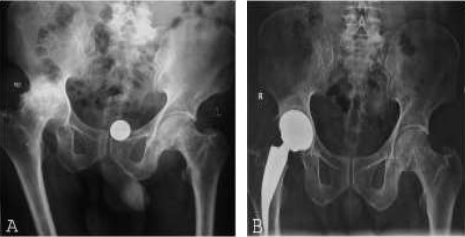
Currently available literature shows good results with cementless total hip arthroplasty in tubercular arthritis of the hip.[18, 19, 20, 21, 22] The authors have no preference on the choice of articulation; however, we prefer a ceramic-on-ceramic articulation in younger patients and ceramic on polyethylene for elderly patients (Fig. 1 A & B).
Fig. 1 Radiograph of pelvis with both hips in Anteroposterior view showing post-tubercular arthritis of right hip in a 24-year-old patient. The patient underwent cementless total hip arthroplasty with modern porous metal cup and short femoral neck preserving stem and Ceramic on Ceramic articulation (A) Post-operative follow up radiograph of pelvis with both hips showing stable total hip arthroplasty prosthesis in situ at 4 years follow up (B).
Principle of Two-Stage and Single-Stage THA in Tuberculous Hip
The principle of THA operation has changed from surgery to single-stage. Single-stage surgery performed by ATT has been shown to be safe and effective in most patients. 13 Li et al.[23] reported good results from two-stage total hip arthroplasty in nine patients, and all of these patients underwent abscess removal and joint debridement two weeks after starting antituberculosis antibiotics. Patients were followed for an average of 4.2 months. In the second stage, total hip arthroplasty is performed and wound healing and blood markers are monitored. Erythrocyte sedimentation rate (ESR) and C-reactive protein (CRP). ATT was continued for 6-9 months after surgery. Ankylosing heals well; however, bony ankylosis may occur during long-term treatment. Nowadays, the history of hip arthroplasty or hip fusion has been changed to provide joint mobility and stability in line with the expectations of patients. The difficulty in converting hip arthroplasty to total hip arthroplasty is the presence of the native acetabulum because it is filled with tissue and is significantly above the femur. On the other hand, if the hip is stiffened by the effect of fibrous ankylosis, the loss of motion will prevent the effect of hip dislocation. Hip arthrodesis or bony ankylosis, if any, presents different evaluations due to previous equipment, lack of anatomy, difficulty in finding the acetabular border and therefore the problem of repairing the acetabular space. [24] In addition, preoperative scar, abductor muscle atrophy, loss of proximal sciatic nerve and proximal femoral anatomy contribute to the safety of performing total hip arthroplasty and ultimately provide a solid union.
Recommendations Depending on the selected installation, partial or complete removal of a previously installed device is required. In any case, in situ femoral neck osteotomy is still a skill. It is recommended to keep the leg long and the knee flexed to keep the sciatic nerve away from the acetabular preparation. During femoral preparation, the abductor muscles should be protected with retractors. Caution should be exercised, especially when removing the device from the proximal femur, as the risk of avulsion of the trochanter is always higher. In this case, the authors prefer modern porous coated acetabular shells, unless there are stability issues from the abductor muscle, where the implant is a dual-action cup. Modular stems can solve problems related to stability and metaphyseal-diaphyseal incompatibility in pediatric tuberculosis patients with femoral canal stenosis.
Limb length inequality is a problem that can only be solved without damaging the sciatic nerve. The same advice should be given to patients before surgery. In general, advanced tuberculous arthritis presents with flexion, adduction, and internal rotation deformities. The tissue released during surgery should be titrated accordingly. When performing total hip replacement from the posterior approach, the gluteus maximus tendon must be completely released during internal femoral pronation to prevent femoral impingement during movement. In most cases, complete capsular release will be sufficient to correct the deformity, but adductor tenotomy is required to achieve full range of motion and equal limb length. Psoas tenotomy may also be required in patients with severe flexion contractures. In rare cases, modified iliotibial band Z-plasty is required when the hip is tight in extension and abduction and externally rotated. Rarely. Relapses are common, especially in immunocompromised patients and those with inflammatory diseases. Relapses or relapses of disease have been reported in patients receiving biologics to treat inflammatory diseases.
Reconstruction and patient counseling to complete ATT remain the mainstay of treatment in all cases. Pneumonia has been reported to be successfully treated with ATT alone without surgery. These do not appear to be related to the underlying TB disease. These patients are treated with implant removal, continued trochanteric osteotomy, use of a Wagner stem on an uncemented stem, or a CPT long stem if the cemented stem is loose. The authors suggested that to control infertility, tissue samples should be taken from 5 different regions of the hip joint, namely the acetabulum, femoral canal and lower acetabulum, and evaluated with bacteria, culture standard histopathology and polymerase chain reaction (PCR) tests. Loosening due to tuberculosis reactivation.
Procedures and surgical importance of total hip arthroplasty in the tuberculous hip, which is always deformed. As a general rule, all such cases should be treated as sepsis due to infection. Inflammatory markers of the disease i.e. All patients should have ESR and CRP performed before surgery to rule out residual disease. While conventional radiographs are sufficient for surgical planning in cases where there is no bone loss, computed tomography (CT) is required when there is the correct localization and amount of bone loss to meet the need for further transplantation. It is best to perform magnetic resonance imaging (MRI) in patients with high markers, especially to exclude residual disease around soft tissue or bone. Samples should then be sent for microbiological examination including AFB staining, culture, polymerase chain reaction (PCR) and histology to obtain evidence and/or exclude nontuberculous mycobacteria (NTM). Although not reported in the hip, nontuberculous mycobacterial infections have been reported in total knee arthroplasty and may cause infection and complications in other countries such as India. > High levels should raise suspicion to assess any recurrence of disease, whether purulent disease or recurrence of tuberculosis.
Monitoring of symptoms, inflammatory conditions and radiographs will help in patient follow-up. THA in patients with chronic hip disease was compared with THA performed for other reasons. It is recommended that all patients get up as soon as possible after surgery and follow up with local total hip replacement. Static exercises when necessary and physical therapy using a walker to provide range of motion should help achieve good results [7,19,20]
Conclusion
Although active, elevated hip surgery for tuberculosis has complications, THA is still a treatment option. It is a good option for improving functional outcomes, early support, and pain relief in such patients. The difficulties are many but can be overcome through pre-planning, careful surgical procedures, and postoperative care. THA should be performed in immunocompetent patients under the protection of preoperative and postoperative antituberculosis drugs.
Reference
1. Jain AK. Tuberculosis of Bones Joints and Spine. Evidence Based Management Guide. first ed. CBS publication; 2017. page 01.
2. Lal H, Jain VK, Kannan S. Tuberculosis of the pubic symphysis: four unusual cases and literature review. Clin Orthop Relat Res. 2013 Oct;471(10): 3372e3380.
3. Babhulkar S, Pande S. Tuberculosis of the hip. Clin Orthop Relat Res. 2002 May;(398):93e99.
4. Saraf SK, Tuli SM. Tuberculosis of hip: a current concept review. Indian J Orthop. 2015 Jan-Feb;49(1):1e9.
5. Tuli SM. Tuberculosis of the Skeletal System (Bones, Joints, Spine, and Bursal Sheaths). 4TH d. New Delhi: Jaypee brothers’ publishers private limited; 2010.
6. Liu CS, Liu FZ, Wang XY, et al. Comparison of total curative effect between total hip arthroplasty and hip arthrodesis in treating coxotuberculosis. Eur Rev Med Pharmacol Sci. 2018 Jul;22(1 Suppl):90e95.
7. Bhosale PB, Jaiswal R, Purohit S, Arte SM. Total hip arthroplasty in 52 active advanced tubercular arthritic hips. J Arthroplasty. 2021 Mar;36(3):1035e1042. https://doi.org/10.1016/j.arth.2020.09.016.
8. Ha KY, Chung YG, Ryoo SJ. Adherence and biofilm formation of Staphylococcus epidermidis and Mycobacterium tuberculosis on various spinal implants. Spine. 2005 Jan 1;30(1):38e43.
9. Wang Y, Wang J, Xu Z, Li Y, Wang H. Total hip arthroplasty for active tuberculosis of the hip. Int Orthop. 2010 Dec;34(8):1111e1114. https://doi.org/10.1007/s00264-009-0854-6.
10. Barik S, Choudhury AK, Singh V, Bali S. Extra-spinal osteoarticular tuberculosis: a retrospective analysis of 103 cases. Curr Health Sci J. 2019 Apr-Jun;45(2): 142e147.
11. Sultan AA, Dalton SE, Umpierrez E, et al. Total hip arthroplasty in the setting of tuberculosis infection of the hip: a systematic analysis of the current evidence. Expet Rev Med Dev. 2019 May;16(5):363e371.
12. Tiwari A, Karkhur Y, Maini L. Total hip replacement in tuberculosis of hip: a systematic review. J Clin Orthop Trauma. 2018 Jan-Mar;9(1):54e57.
13. Neogi DS, Yadav CS, Kumar Ashok, Khan SA, Rastogi S. Total hip arthroplasty in patients with active tuberculosis of the hip with advanced arthritis. Clin Orthop Relat Res. 2010 Feb;468(2):605e612.
14. Kim SJ, Postigo R, Koo S, Kim JH. Total hip replacement for patients with active tuberculosis of the hip: a systematic review and pooled analysis. Bone Joint Lett J. 2013 May;95-B(5):578e582.
15. Sidhu AS, Singh AP, Singh AP. Total hip replacement in active advanced tuberculous arthritis. J Bone Joint Surg Br. 2009 Oct;91(10):1301e1304.
16. Hardinge K, Cleary J, Charnley J. Low-friction arthroplasty for healed septic and tuberculous arthritis. J Bone Joint Surg Br. 1979 May;61-B(2):144e147.
17. Dogra AS, Kulkarni SS, Bhosale PB. Total hip arthroplasty in healed tuberculous hip. J Postgrad Med. 1995 Oct-Dec;41(4):114e116.
18. Kumar V, Garg B, Malhotra R. Total hip replacement for arthritis following tuberculosis of hip. World J Orthoped. 2015 Sep 18;6(8):636e640.
19. Wang Q, Shen H, Jiang Y, et al. Cementless total hip arthroplasty for the treatment of advanced tuberculosis of the hip. Orthopedics. 2011 Jan 1;34(2): 90.
20. Zeng M, Hu Y, Leng Y, et al. Cementless total hip arthroplasty in advanced tuberculosis of the hip. Int Orthop. 2015 Nov;39(11):2103e2107.
21. Yoon TR, Rowe SM, Santosa SB, Jung ST, Seon JK. Immediate cementless total hip arthroplasty for the treatment of active tuberculosis. J Arthroplasty. 2005 Oct;20(7):923e926.
22. Shen H, Wang QJ, Zhang XL, et al. [Cementless total hip arthroplasty for the management of advanced tuberculous coxitis]. Zhonghua Yi Xue Za Zhi. 2012 Sep 18;92(35):2456e2459.
23. Li L, Chou K, Deng J, et al. Two-stage total hip arthroplasty for patients with advanced active tuberculosis of the hip. J Orthop Surg Res. 2016 Mar 30; 11:38.
24. Fu Y, Yang D, Asihaerjiang-Maimaitiyiming, Cao L, Guo W. Research of acetabular orientation determination and accuracy in total hip arthroplasty for bony ankylosed hip. Zhongguo Xiu Fu Chong Jian Wai Ke Za Zhi. 2015 Apr;29(4): 426e430.
25. Hugate Jr R, Pellegrini Jr VD. Reactivation of ancient tuberculous arthritis of the hip following total hip arthroplasty: a case report. J Bone Joint Surg Am. 2002 Jan;84(1):101e105.
26. Kim YH, Han DY, Park BM. Total hip arthroplasty for tuberculous coxarthrosis. J Bone Joint Surg Am. 1987 Jun;69(5):718e727.