A Retrospective Cross-Sectional Descriptive Study of Outcomes of Children with Downs Syndrome Who Underwent Cardiac Catheter Intervention for Congenital Heart Lesions
A Retrospective Cross-Sectional Descriptive Study of Outcomes of Children with Downs Syndrome Who Underwent Cardiac Catheter Intervention for Congenital Heart Lesions
Dr Mohamed Sobh1*, Dr. Waleed El Lithy2, Dr. Salem Al Maskari3, Dr khalid Al Alawi4, Dr Abdullah Al Farqani5
1,2. Pediatric Cardiologist
3, 4, 5. Dr. Salem Al Maskari Consultant Pediatric Cardiology Intervention and Pediatric Cardiology
Correspondence to: Dr Mohamed Sobh, Department of pediatric cardiology, National heart center, Royal Hospital, Oman.
Copyright
© 2025 Dr Mohamed Sobh. This is an open access article distributed under the Creative Commons Attribution License, which permits unrestricted use, distribution, and reproduction in any medium, provided the original work is properly cited.
Received: 30 Jan 2025
Published: 05 Feb 2025
ABSTRACT
Objective: Congenital heart disease (CHD) is prevalent in children with Down syndrome (DS), affecting 50.3% of cases. This study examines the demographic and geographic distribution, outcomes, and complications of cardiac catheter interventions in DS children in Oman from 2010 to 2020. Among 807 children with DS, 55 (13.5%) underwent cardiac catheter interventions. Procedural details, outcomes, and complications were analyzed, with a median follow-up of 2.4 years. Results: The majority of catheter interventions involved device closures, including PDA (49%), ASD (28%), and VSD (21%). Residual defects decreased from 30.4% post-procedure to 7.1% at the last follow-up. Femoral artery thrombosis occurred in 16.5% of patients, predominantly with Amplatzer devices and was associated with prolonged hospital stays. Survival at follow-up was 98.2%, with one death (1.7%) reported. Median age and weight at intervention were 2.3 years and 10.2 kg, respectively. Conclusion: Cardiac catheterization in DS children demonstrates low mortality and manageable complications, with vascular issues being the most common. Improved awareness and care protocols are essential to reduce adverse events. Future studies should explore survival outcomes compared to non-DS children and assess risk factors for vascular complications.
A Retrospective Cross-Sectional Descriptive Study of Outcomes of Children with Downs Syndrome Who Underwent Cardiac Catheter Intervention for Congenital Heart Lesions
Abbrevations
|
ASD |
Atrial septal defect |
|
AVSD |
Atrioventricular septal defect |
|
CHD |
Congenital heart disease |
|
DS |
Down syndrome |
|
LPA |
Left pulmonary artery |
|
PDA |
Patent ductus arteriosus |
|
RPA |
Right pulmonary artery |
|
SD |
standard deviation |
|
VSD |
Ventricular septal defect |
Introduction
DS is the most common chromosomal with a range of morphological and structural birth defects. These include congenital mental disability, hypotonia, distinctive physical features, heart defects, and other systemic malformations. The incidence of CHD in children with DS is estimated to range from 40% to 50% (1). Atrioventricular septal defect (AVSD) is the most common cardiac anomaly, accounting for 45% of cases, followed by ventricular septal defect (VSD), atrial septal defect (ASD), and tetralogy of Fallot. AVSD is the most frequently reported congenital heart defect in Western literature (2,3). CHD is the leading cause of mortality and a key determinant of outcomes in children with DS. Vascular complications are the most common adverse events following cardiac catheterization in children (4).
Limited data exist regarding the outcomes of children with DS who underwent cardiac catheter intervention in Oman. Therefore, this study describes the demographic and geographic distribution of DS patients in Oman who underwent cardiac catheter intervention between 2010 and 2020. It also examines survival after cardiac catheter intervention and the incidence of complications (mainly femoral artery thrombosis).
Methods
This is a retrospective cross-sectional descriptive study. The clinical data were extracted from the Alshifa system for patients in Oman who underwent cardiac catheter intervention between 2010 and 2020. The study was approved by the ethical committee.
Statistical analysis was done using SPSS v26 (IBM Inc., Chicago, IL, USA). Quantitative variables were presented as mean and standard deviation (SD) and compared between the two groups utilizing an unpaired Student's t-test. Qualitative variables were presented as frequency and percentage (%) and were analyzed utilizing the Chi-square test or Fisher's exact test when appropriate. A two-tailed P value <0.05 was considered statistically significant and a P value <0.001 was considered highly statistically significant.
Results
Among the 807 children with DS, 50.3% had Congenital heart defects. Congenital heart defects were significantly more common in females (65.5%) than males (34.5%).228(56.2%) children had undergone surgical repair for an atrioventricular canal defect, 123 (30.3%) children underwent surgical procedures for congenital heart diseases other than atrioventricular septal defect (AVSD) repair and 55(13.5%) children underwent catheter intervention (table 1,2). Additionally, 401(49.7%) had no intervention including children who had normal cardiac structures and those who experienced spontaneous closure of their congenital heart diseases. Patent foramen ovale and spontaneously closed defects were considered normal.
Table (1): Distribution of studied cases according to demographic data
|
Variables |
N=55 |
|
Age (months) |
|
|
Mean ± SD |
10.9 ± 5.9 |
|
Gender |
N (%) |
|
Male |
19 (34.5%) |
|
Female |
36 (65.5%) |
|
Weight (Kg) |
|
|
Mean ± SD |
2.85 ± 1.80 |
Table (1): shows that the mean age of Down syndrome cases was 10.9 ± 5.9, 65.5% were female, 34.5% were males and the mean weight was 2.85 ± 1.80.
Table (2): Distribution of studied cases according to primary diagnosis
|
Diagnosis |
N=55 |
|
VSD |
17 (30.9%) |
|
ASD |
23 (41.8%) |
|
PDA |
31 (56.4%) |
|
Aortopulmonary collateral |
1 (1.8%) |
|
RPA stenosis |
2 (3.6%) |
|
LPA stenosis |
1 (1.8%) |
Table (2): shows that the most common diagnosis was PDA (56.4%), followed by (41.8%) ASD, 30.9% VSD, 3.6% had RPA stenosis, 1.8% had Aortopulmonary collateral and 1.8% had LPA stenosis.
Table (3): Distribution of studied cases according to associated lesion
|
Associated lesion |
N=55 |
|
Hypothyroidism |
5 (9.1%) |
|
Hennoch schonlein pupura |
2 (3.6%) |
|
Asthma |
3 (5.5 %) |
|
cystic hygroma |
2 (3.6%) |
|
Obesity |
2 (3.6%) |
|
cystic hygroma |
2 (3.6%) |
|
Hirschsprung |
2 (3.6%) |
|
Diaphragmatic Hernia |
2 (3.6%) |
Table (3): shows that the most common diagnosis was hypothyroidism (9.1%) followed by asthma (5.5%).
Out of a total of 55 patients who underwent catheter intervention. Twenty-seven children (49.1%) underwent PDA device closure, ASD device closure was Conducted in 18 children (32.7%), as well as VSD device closure was performed on 12 children (21.8 %), Additionally three children underwent Left Pulmonary Artery (LPA) stent, Right Pulmonary Artery (RPA) balloon angioplasty and Aortopulmonary collateral device closure, each with a percentage of 1.8%. Only 2 patients (3.6%) required reintervention. Also, 4 patients (7.3%) underwent device closure for two different defects (Table 4). Most of the patients 48 children (87.2%), had follow-up at our center, while the remaining received their follow-up at the nearest peripheral centers.
Table (4): Distribution of studied cases according to catheter intervention procedures
|
Cardiac cath procedure |
N=55 |
|
Age at procedure (months) |
|
|
Mean ± SD |
2.9 ± 5.9 |
|
Weight at procedure (Kg) |
|
|
Mean ± SD |
11.09 ± 1.80 |
|
Type of procedure |
N (%) |
|
VSD device closure |
12 (21.8%) |
|
ASD device closure |
18 (32.7%) |
|
PDA device closure |
27 (49.1%) |
|
RPA balloon angioplasty |
1 (1.8%) |
|
Aortopulmonary collateral device closure |
1 (1.8%) |
|
LPA stent |
1 (1.8%) |
Table (4): shows that age at the procedure was 2.9 ± 5.9 months, weight at the procedure was 11.09 ± 1.80, 49.1% had PDA device closure, 21.8% had VSD device closure and 32.7% had ASD device closure.
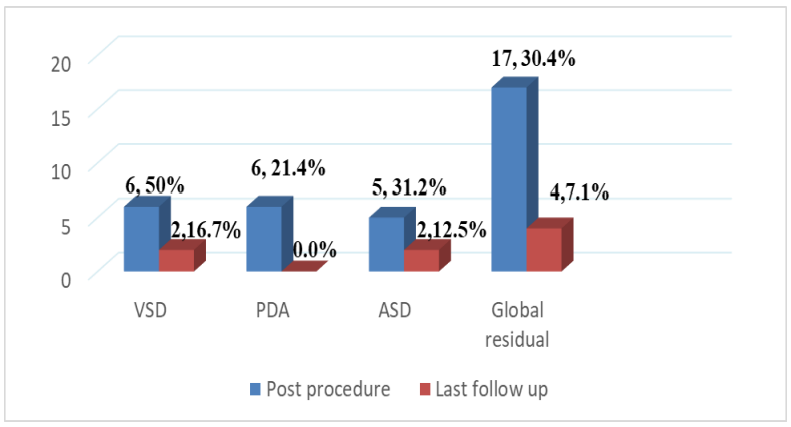
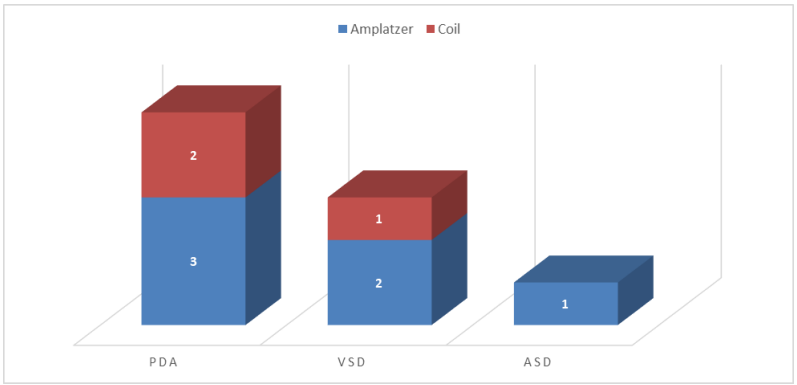
17 children (30.5%) had a residual defect at 1st post-procedure Echocardiogram, but this came down in the last follow-up to 4 children (7.3%) (Figure 1). Moreover, 54 children (99.2%) were electively admitted. The median time between the last follow-up and the date of the procedure is 2.4(0.1-13.4) years. 1 patient (1.8%) passed away 8 months post-procedure due to chest infection (Table 5). Additionally, due to lower limb thrombosis, 9 of these patients (16.5%) experienced a prolonged hospital stay, mostly associated with the Amplatzer device (Figure 2).
Table (5): Distribution of studied cases according to outcome
|
Outcome |
N=55 |
|
Hospital stay (days) |
|
|
Mean ± SD |
3 ± 6 |
|
Outcome |
N (%) |
|
Survived |
54 (98.2%) |
|
Dead |
1 (1.8%) |
|
Residual lesion post-procedure |
N (%) |
|
Yes |
17 (30.5%) |
|
No |
36 (69.5%) |
|
Need for reintervention |
N (%) |
|
Yes |
2 (3.6%) |
|
No |
53 (96.4%) |
|
Echo abnormalities at the last follow-up |
N (%) |
|
Yes |
4(7.3%) |
|
No |
47 (92.7%) |
Table (5): shows that the mean of hospital stay was 3 ± 6 days, mortality rate was 1.8%, 34.5% had residual lesion, 3.6% need reintervention. While Echo abnormalities at the last follow-up were seen in only 14.5%.
Figure 1. Residual lesions post-procedural and in the last follow-up TTE
Figure 2. Lower limb thrombosis associated with cardiac defect and closure device type.
Discussion
This study assesses the incidence of complications, particularly femoral artery thrombosis, survival outcomes following cardiac catheter intervention, and the demographic and geographic distribution of DS patients in Oman who underwent the procedure between 2010 and 2020. CHD is the most prevalent structural defect observed in children diagnosed with DS, occurring in 50.3% of children with DS, consistent with the 40%-60% range reported in several studies of DS patients (5,6).
This prevalence is more pronounced in Arab countries, attributed to elevated rates of consanguineous marriage, as well as higher incidences of diabetes and obesity (7). The prevalence of CHD is higher in girls with DS (65.5%) compared to boys (34.5%), as reported by Diogenes TCP et al., 2017 and Santoro M et al., 2018(8,9).
In this study, we found that the most prevalent diagnosis among children with DS was hypothyroidism, occurring in 9.1%, followed by asthma at 5.5%. A previous study by Alkaya et al. reported a hypothyroidism prevalence of 25.3%. Congenital hypothyroidism was observed in 6 patients (1.8%) and 5 of whom had CHD (3).
DS may independently elevate the risk of thromboembolic disease in children. Vascular complications are the most frequent complication of pediatric cardiac catheterization (10). According to existing literature, the incidence rate of femoral venous thrombosis following cardiac catheterization ranges from 0% to 20% in infants and children. Similarly, the incidence rate of femoral arterial thrombosis varies between 0.8% and 40% (11).
We reported femoral artery thrombosis in 16.3% of patients (9 patients) with a median age of 6 months, consistent with findings from Kamyszek et al. (2019) and Bansal et al. (2021), which showed that patients younger than 12 months and weighing less than 10 kg were at high risk for pulse loss after catheterization. The detection rate of vascular complications increased from 8.3% to 23.4% in infants under 6 months of age following the implementation of routine post-catheterization vascular assessment using Doppler ultrasound. (12,13).
DS children with CHD had a significantly lower survival rate compared to those without CHD (14). The survival rate at one year of follow-up was 1.8%, which is lower than the rates reported by Morales-Demori et al. (2017) and Orazah Zahari et al. (2019), which indicated survival rates of 90% at one year and 80% at five years, respectively (15, 16).
Limitation
The limitations of the study include a small sample size and a heterogeneous distribution of gestational ages among the cases. Additionally, the evaluation of clinical findings related to thrombosis may show individual variations.
Conclusion
Cardiac catheterizations in children with Down syndrome (DS) can be performed with low risk. Vascular complications are the most common adverse events overall. Increased awareness of these complications has improved intensive care, which may help reduce their incidence. Future studies should compare the survival rates of children with DS who undergo cardiac catheterization to those of non-DS children with congenital heart disease (CHD) and identify risk factors for femoral thrombosis.
References
1. Mourato FA, Villachan LRR, Mattos SS. Prevalence and profile of congenital heart disease and pulmonary hypertension in Down syndrome in a pediatric cardiology service. Rev Paul Pediatr. 2014;32(2):159–63.
2. Ishikawa T, Iwashima S, Ohishi A, Nakagawa Y, Ohzeki T. Prevalence of congenital heart disease assessed by echocardiography in 2067 consecutive newborns. Acta Paediatr. 2011;100(8):e55–60.
3.El-Shazali O, Ahmed H, El-Shazali H. The spectrum of congenital heart defects in infants with Down syndrome, Khartoum, Sudan. J Pediatr Neonatal Care. 2015; 2:91.
4. Martin T, Smith A, Breatnach CR, Kent E, Shanahan I, Boyle M, et al. Infants Born with Down Syndrome: Burden of Disease in the Early Neonatal Period. The Journal of Pediatrics. 2018? 193: 21–26
5. Zahari N, Mat Bah MN, A Razak H, Thong MK. Ten-year trend in prevalence and outcome of Down syndrome with congenital heart disease in a middle-income country. Eur J Pediatr. 2019 Aug;178(8):1267-1274.
6. Alkaya DU, Öztürk B, Ülker AY, Bozlak S, Öztürk E, Dedeo?lu R et al. Congenital Heart Defects and Outcome in a Large Cohort of Down Syndrome: A Single-Center Experience from Turkey. Turk Arch Pediatr. 2023 Sep; 58(5): 473–479.
7. Zonouzi AAP, Ahangari N, Rajai S, Zonouzi A, Laleh M, Nejatizadeh A. Congenital birth defects among Down syndrome patients: a clinical profile. J Public Health. 2016;24:57–63.
8. Diogenes TCP, Mourato FA, de Lima Filho JL, Mattos SDS. Gender differences in the prevalence of congenital heart disease in Down’s syndrome: a brief meta-analysis. BMC Med Genet. 2017;18(1):111. ( 10.1186/s12881-017-0475-7)
9. Santoro M, Coi A, Spadoni I, Bianchi F, Pierini A. Sex differences for major congenital heart defects in Down syndrome: a population-based study. Eur J Med Genet. 2018;61(9):546 550.
10. Okel K, Gümü? A, Ayabakan C, Varan B, & Erdo?an ?. Complications of cardiac catheterization in children with congenital heart disease. Department of Pediatric Cardiology, Baskent University Ankara Hospital, Ankara, Turkey. The Turkish Journal of Pediatrics 2018; 60: 675-683.
11. Rizzi M, Goldenberg N, Bonduel M, Revel-Vilk S, Amankwah E, Albisetti M. Catheter-Related Arterial Thrombosis in Neonates and Children: A Systematic Review. Thromb Haemost. 2018 Jun;118(6):1058-1066. doi: 10.1055/s-0038-1642635. Epub 2018 Apr 25.
12. Bansal N, Misra A, Forbes TJ, Kobayashi D. Femoral Artery Thrombosis After Pediatric Cardiac Catheterization. Pediatr Cardiol. 2021 Apr;42(4):753-761. doi: 10.1007/s00246-020-02537-2. Epub 2021 Jan 25.
13. Kamyszek RW, Leraas HJ, Nag UP, Olivere LA, Nash AL, Kemeny HR et al. Routine postprocedure ultrasound increases the rate of detection of femoral arterial thrombosis in infants after cardiac catheterization. Catheter Cardiovasc Interv. 2019 Mar 1;93(4):652-659. doi: 10.1002/ccd.28009. Epub 2018 Nov 23.
14. Syndrome on Survival Among Patients With Congenital Heart Disease. J Am Heart Assoc.2024 Jan 16;13(2):e031392. doi: 10.1161/JAHA.123.031392. Epub 2024 Jan 12.
15. Morales-Demori, R. Congenital heart disease and cardiac procedural outcomes in patients with trisomy 21 and Turner syndrome. Congenital Heart Dis. 2017 Dec;12(6):820-827. doi: 10.1111/chd.12521. Epub 2017 Jul 24.
16. Zahari N, Mat Bah MN, A Razak H, Thong MK. Ten-year trend in prevalence and outcome of Down syndrome with congenital heart disease in a middle-income country. Eur J Pediatr. 2019 Aug;178(8):1267-1274. doi: 10.1007/s00431-019-03403-x. Epub 2019 Jun 20.