Use of the Happiness Toolkit for Children with Social, Emotional, and Mental Health Issues in an Outpatient Setting.
Use of the Happiness Toolkit for Children with Social, Emotional, and Mental Health Issues in an Outpatient Setting.
K. Sampson 1*, L. Sharif 2, A. Corcoran2, S. Rizvi 2, F. Sharif 1,2,3.
1. RCSI University of Medicine and Health Sciences, Dublin, Ireland.
2 Department of Paediatrics, Mullingar Regional Hospital, Westmeath, Ireland.
3 Clinical Associate Professor of Paediatrics, University College Dublin, Ireland.
*Correspondence to: Kara Sampson, 7 Eden Grove Rathfarnham Dublin 16, 0877719546.
Copyright
© 2025: K. Sampson. This is an open access article distributed under the Creative Commons Attribution License, which permits unrestricted use, distribution, and reproduction in any medium, provided the original work is properly cited.
Received: 27 Feb 2025
Published: 01 Apr 2025
Abstract:
Objectives: This study aimed to explore whether The Happiness Toolkit was effective in helping children with emotional dysregulation and their families to engage in positive mental health practices and whether these practices could boost self-esteem, develop resilience, and promote positive mental health while awaiting assessment from psychiatry services.
Design: After receiving ethical approval, this prospective pilot study was conducted in paediatric outpatient clinics at Mullingar Regional Hospital over 4 weeks. A total of 53 children attended these clinics, all of whom agreed to participate after they and their parents received information leaflets about the study. All 53 children were screened with the Ages and Stages Questionnaire: Social-Emotional, Second Edition (ASQ: SE2) or Paediatric Symptom Checklist (PSC) on presentation, and a total of 23 patients screened positive for emotional dysregulation or mental health difficulties. 3 of these patients subsequently withdrew from the study. A therapeutic alliance was established with the remaining 20 patients, a detailed history and physical exam were taken, and the clinician explained the toolkit in detail. Data was collected pseudo-anonymised, and parents were contacted 4-6 weeks later to complete a structured questionnaire.
Results: Of the 20 patients participating in the study, 10 (50%) were awaiting psychology/psychiatry intervention, and 50% of these had been waiting for more than one year. A total of 90% of patients reported improvements in their symptoms at follow-up, with 10% reporting no change. Most parents reported feeling their relationship with their child had improved and that their child was more open with them. Parents of children with ASD and intellectual disabilities found the toolkit somewhat difficult to use. Some patients found the toolkit hard to fit into their busy daily schedule.
Conclusion: This study has highlighted the effectiveness of the ‘Happiness Toolkit’ in enhancing and supporting the mental health of children with emotional dysregulation and mental health conditions in the outpatient setting.
Use of the Happiness Toolkit for Children with Social, Emotional, and Mental Health Issues in an Outpatient Setting.
Strengths and Limitations of the study:
• This prospective pilot study had a clear and well-defined research objective: exploring whether The Happiness Toolkit can lead to children’s improved mental health in the outpatient setting and act as a bridge to psychology or CAHMS assessment.
• Inclusion and exclusion criteria were explicitly developed.
• The data collected was pseudo-anonymised, maintaining patient confidentiality.
• This study was only carried out in one centre, in a regional hospital.
• The Happiness Toolkit was reported as somewhat difficult to use for children and young people with autism spectrum disorder (ASD) or an intellectual disability.
Introduction
The children and young people of Ireland are currently facing a crisis of mental health, which the COVID-19 pandemic and subsequent lockdowns have exacerbated. Recent years have seen an exponential rise in the demand for youth mental health services, and due to a lack of sufficient services nationwide, vulnerable young people and their families are being left without support.
Anxiety, depression, and behavioural disorders are the most commonly diagnosed mental health disorders in children, with some of these conditions commonly occurring together14. Based on data from 2018-2019, treatment accessed by young people varies greatly depending on their age and their diagnosis, with 79% of children diagnosed with depression eventually receiving some form of intervention, but only 59% of those with anxiety and 52% of those with behavioural disorders14.
A recent publication of the ‘Growing Up in Ireland’ national longitudinal study (July 2023) looked at the social and emotional health of 13-year-olds in Ireland. As reported by this study, 14% of participants were found to have ‘low mood’ when tested with the ‘Mental Health Inventory’ measure. 14% of female respondents were found to have low self-esteem (vs 6% of male respondents), and 9% were noted to suffer from some social/ emotional or mental health difficulty as noted by their parent1.
The ’My World Survey 2’, a national study of youth mental health in Ireland (which surveyed over 10,000 Irish young people ranging in age from 12-19 years), reported in 2019 that 40% of the young people who took part suffered from depression, and almost half (49%) suffered from anxiety. Worryingly, of those adolescents who attempted to take their own lives, less than half (43%) reported having access to adequate support. The resilience, self-esteem and optimism levels in this cohort, which are seen as protective factors for mental health, had decreased since the previous survey in 20122.
The increasing prevalence of mental health disorders in children and young people is not unique to Ireland. In October 2024, the World Health Organisation (WHO) reported that globally, whilst one in seven 10-19-year-olds experience a mental health disorder, most of these young people will not have access to suitable support. The WHO has also reported suicide as the third leading cause of death amongst 15-29-year-olds worldwide, the risk factors for which are varied and include barriers to accessing care and stigma against health-seeking behaviours3. Alarmingly, UNICEF has reported Ireland as having the fourth highest level of suicide amongst young people in Europe4.
The COVID-19 pandemic may be one of the many factors which have led us to this current crisis, with children suffering disproportionate disruptions to their social and academic lives during important developmental years due to the many lockdowns they experienced5. A paper by McNicholas & Moore (2022) reported that while overall attendances at a Dublin paediatric hospital were lower during the pandemic, the proportion of mental health presentations was much higher compared to pre-pandemic levels. O’Sullivan et al. (2021) also reported that the COVID-19 lockdowns were directly associated with increased levels of anxiety and fear in younger children, which led to an increase in overall negative behaviours12. It was also noted that the closure of schools inadvertently led to increased difficulty in accessing mental health support due to children and their families no longer having access to the mental health services they usually provide.
Referrals to Child and Adolescent Mental Health Services (CAHMS) increased during the original COVID lockdown, with an increase of 180% between March 2020 and November 2020. As referrals to CAHMS were already increasing pre-COVID, this alarming rise placed a significant burden on an already overstretched service5.
Worryingly, a further 33% increase in CAHMS referrals between 2020 and 2021 has been noted, and the number of children on waiting lists rose from 2,755 to 4,434 between December 2020 and February 2023. Children are now waiting up to two years to receive any form of intervention with CAHMS, a wait which could lead to the exacerbation of the original mental health condition for which the referral was made6.
Clearly, we are at a crisis point, with the current provision of mental health services nationwide not coming close to meeting the needs of vulnerable young people in need of support. Healthcare workers are struggling to cope with the increased demands placed on them, and a solution must be found. One possibility is using the ‘Happiness Toolkit’ in the outpatient setting as an early intervention tool while patients await intervention from psychology and/or CAHMS.
The Happiness Toolkit
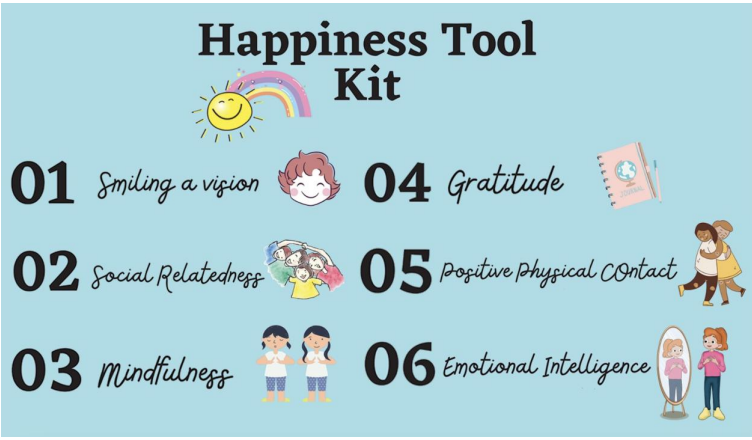
The Happiness Toolkit is an effective tool that primary and secondary care providers can use to develop self-care skills to improve overall well-being. Children and their families are encouraged to include The Happiness Toolkit into their everyday routine to improve their social, emotional and mental health. The toolkit includes six self-care skills: smiling a vision, social relatedness, mindfulness, gratitude, positive physical contact, and emotional intelligence, the neurological basis of which are discussed at length in a recent paper14. Alongside the toolkit, patients will receive a ‘Happiness Diary’. This diary allows children and their parents to record the daily practice of their self-care skills. The diary also contains daily positive affirmations and information about healthy eating, which can help promote the child’s wellbeing14.
When introducing the toolkit, a therapeutic alliance must first be established between the patient and the clinician. A detailed history and physical exam must be undertaken, and screening for anxiety or other social/emotional or behavioural disorders can be performed using standardised screening tools. If the child scores above the cut-off or in the borderline zone, the ‘Happiness Toolkit’ can be explained to both the child and their parent/caregiver. The paediatrician can explain the self-care skills in detail to the patient, and if the patient is agreeable, a contract can be signed stating that they will practice these skills at home to allow the child to take ownership of their own wellbeing.
The six components of the toolkit can be seen below in Figure 1.
Figure 1. The Happiness Toolkit.
When undertaking the self-care skill of ‘smiling a vision’, children are asked to think of happy memories or future aspirations. They are encouraged to smile genuinely whilst doing so to strengthen the associated mental health benefits7. Children may visualise themselves spending time with a loved one or achieving a future goal. Having goals and a purpose in life is one of the many mechanisms underlying resilience8, which can protect children from negative events they may encounter.
The ‘social relatedness’ pillar encourages children to spend meaningful time with a loved one and to participate in community-based events. These events could be many different activities like sports teams or music classes. Parents are taught about the 5 Rs of healthy brain development (Reading, Rhyming, Routine, Reward and Relationships9) and encouraged to incorporate these into their everyday routine with their child.
Both improved behavioural regulation and improvements in perceived mental well-being are direct benefits of the practice of mindfulness10. Age-appropriate techniques, including deep breathing, spending time in nature, and taking a moment to appreciate the beauty of their surroundings, are recommended by the toolkit to facilitate the child’s engagement with mindfulness. The use of mindfulness may allow the child to develop coping mechanisms that can be used long-term.
The ‘Happiness Diary’ can be used to help children practice gratitude. The toolkit asks children to engage in gratitude by starting their day by writing down three things they are grateful for or ending their day by jotting down what made them happy during that day. Gratitude has been shown to hold many benefits for both physical and mental health, which remain long-term, so children who practice gratitude may continue to benefit from this practice well into adulthood13.
Children are encouraged to hug their parents, carers, or other family members when participating in' positive physical contact’. Children can also hug their parents whilst doing other activities, such as reading bedtime stories, as this activity has been shown to reduce negative psychological reactions such as stress in children11. Positive physical contact with a loved one has also been shown to set off many biological cascades, which include the release of oxytocin, the release of which has been shown to increase feelings of safety and happiness.
Lastly, ‘emotional intelligence’ can be developed by encouraging empathy, teaching young people to be more self-assured, and integrating kindness towards themselves and others.
The techniques explained above have all been proven to promote positive mental health and develop resilience and self-esteem. The Happiness Toolkit could be an invaluable early intervention tool for children and their parents to engage with in the outpatient setting while awaiting CAHMS assessment.
Methods
Before commencing the study, ethical approval was received from the HSE Reference Research Ethics Committee (Midlands, Regional Health Area B). This prospective pilot study then took place in the paediatric outpatient department of Midlands Regional Hospital, Mullingar, over the course of 4 weeks.
A total of 53 children attended paediatric outpatient clinics in Mullingar Regional Hospital when this study was being carried out. All 53 children presenting to the clinic and their parents were provided with leaflets detailing the study to obtain their informed consent for taking part. As a result, all 53 children and their parents agreed to take part, and children were then screened with the ASQ: SE2 or PSC to identify those children with social-emotional or behavioural difficulties.
Of these 53 children, 23 screened positive for social, emotional or behavioural difficulties and thus were included in the study. Subsequently, 3 patients withdrew from the study. A therapeutic alliance was established, a detailed history was taken, and a physical examination was conducted on each of the 20 participants. The clinician explained the toolkit in detail. Patients and their parents were given two copies of The Happiness Toolkit and asked to keep one in their bedroom and one in the family sitting room to aid compliance. Children and parents were asked to use the toolkit together for the next 4-6 weeks, after which they were contacted and asked to complete a structured questionnaire regarding their experiences with the toolkit. Data was collected in a pseudo-anonymised way.
Results
Of the 20 patients who screened positive and remained in the study, 30% were between 1-5 years of age (n=6), 10% were between 6-10 years of age (n=2), and 60% were between 11-16 years of age (n=12). 10 of these children (50%) were awaiting psychology/psychiatry appointments. Half of them had been waiting for more than one year.
At follow-up 4-6 weeks later, 90% of patients reported an improvement in their symptoms, 50% reported cessation of their symptoms, 40% reported some improvement, and 10% reported no change. 50% of patients also reported practicing The Happiness Toolkit daily, 30% reported practicing it every other day, and 15% reported practicing it once or twice a week.
The majority of parents reported that their relationship with their child had improved and that their child was now more open with them about any issues they were facing.
Some parents also reported that the toolkit helped them to deal with their children’s challenging behaviours and that they had practiced the toolkit themselves to help deal with the stress and anxiety they were experiencing as a result of their child’s challenging behaviours.
Several parents also reported that the toolkit was difficult to use with children who had ASD or an intellectual disability. Some patients also found incorporating the toolkit into their busy daily schedule difficult. Some of the older children included in the study also suggested getting access to a more age-appropriate version of the toolkit as they felt the current toolkit was more suited to younger children.
Conclusion
This study illustrates how secondary intervention, in the form of The Happiness Toolkit, in the paediatric outpatient setting can benefit children and young people with emotional dysregulation or behavioural difficulties while they await input from psychology/psychiatry services.
A significant number of children included in this study reported an improvement in their symptoms after using The Happiness Toolkit for a period of 4-6 weeks. This result is extremely promising given the ever-growing paediatric waiting lists for psychology/psychiatry appointments and the rapidly increasing levels of mental health difficulties that are being seen to affect the children and young people in Ireland today.
Conflicts of interest: the authors declare that they have no conflicts of interest.
Patient consent for publication: patient consent for publication has been recorded.
Funding: there was no specific grant for this research from any funding agency in the public, commercial or not-for-profit sectors.
Data statement: data is not available.
References
(1) Growing Up in Ireland Study Team (2023). Key Findings: Cohort ’08 at 13 Years Old. Dublin: DCEDIY/ESRI/TCD.
(2) My World Survey 2. The National Study of Youth Mental Health in Ireland. B. Dooley, C. O’Connor, A. Fitzgerald, A. O’Reilly. 2019.
(3) World Health Organisation. Mental Health of Adolescents. 10 October 2024. Available from: https://www.who.int/news-room/fact-sheets/detail/adolescent-mental-health.
(4) UNICEF. Building the Future: Children and the Sustainable Development Goals in Rich Countries; UNICEF: New York, NY, USA, 2017.
(5) McNicholas F, Moore K. Covid-19, child & adolescent mental health services (CAMHS) and crises. Irish medical journal. 2022 Jan 20;115(1):522-.
(6) Irish Times. Ireland’s growing mental health crisis for children and young people adds to a system under pressure. S. Bowers, 2nd June 2023. Available at: https://www.irishtimes.com/health/2023/06/02/a-pill-for-social-ills-wont-solve-the-growing-mental-health-crisis-for-children-and-young-people-experts-say/
(7) Power, Edmond; Taaffe, Sarah; McLoughlin, Patricia; Sharif, Farhana (2022): Primary and secondary care approach to paediatric mental health conditions: a novel model of care. Royal College of Surgeons in Ireland. Journal Contribution. https://hdl.handle.net/10779/rcsi.20941225.v1
(8) Schaefer SM, Morozink Boylan J, van Reekum CM, et al. Purpose in life predicts better emotional recovery from negative stimuli. PLoSOne 2013;8: e80329.
(9) High PC, American Academy of Paediatrics Committee on Early Childhood, Adoption, and Dependent Care and Council on School Health. School readiness. Paediatrics 2008;121: e1008–15.
(10) Keng S-L, Smoski MJ, Robins CJ. Effects of mindfulness on psychological health: a review of empirical studies. Clin Psychol Rev2011; 31:1041–56
(11) Morrison I. Keep calm and Cuddle on social touch as a stress buffer. Adapt Human Behaviour Physiology 2016; 2:344–62.
(12) O’Sullivan K, Clark S, McGrane A, Rock N, Burke L, Boyle N, Joksimovic N, Marshall K. A qualitative study of child and adolescent mental health during the COVID-19 pandemic in Ireland. International journal of environmental research and public health. 2021 Feb;18(3):1062.
(13) CDC, centre of Disease Control and Prevention, Children Mental Health, Available at: Data and Statistics on Children's Mental Health | CDC
(14) Sawant T, Saha Z, Sharif F. Neurological Bases underlying the ‘Happiness Toolkit’: A model of care for children with social, emotional and/or mental health issues. Unpublished.