The Happiness Toolkit: A Novel Model of Care for Treating Social, Emotional and Mental Health Disorders for Children in an Inpatient Setting.
The Happiness Toolkit: A Novel Model of Care for Treating Social, Emotional and Mental Health Disorders for Children in an Inpatient Setting.
K Sampson1*, M Md Isa2, N Ali2, F Sharif1,2,3
1 Royal College of Surgeons in Ireland (RCSI), Ireland
2 Paediatric Department, Mullingar Regional Hospital, Ireland
3 School of Medicine, University College of Dublin, Ireland
*Correspondence to: Kara Sampson, 7 Eden Grove Rathfarnham Dublin 16, 0877719546.
Copyright
© 2025: K. Sampson. This is an open access article distributed under the Creative Commons Attribution License, which permits unrestricted use, distribution, and reproduction in any medium, provided the original work is properly cited.
Received: 27 Feb 2025
Published: 01 Apr 2025
Abstract:
Objectives: This study aimed to explore whether The Happiness Toolkit can help children and their families to engage in positive mental health practices and whether these practices can lead to the child’s improved mental health or cessation of symptoms. The Happiness Toolkit is a resource which encourages children to develop self-care skills to promote and support well-being and improve mental health. The toolkit outlines six evidence-based techniques: smiling a vision, social relatedness, mindfulness, gratitude, positive physical contact, and emotional intelligence.
Design: A retrospective chart review was conducted, looking at children under the age of 16 who were admitted to the paediatric unit of a regional hospital in Ireland with emotional dysregulation between May 2022 and September 2023. These children received intervention with The Happiness Toolkit during their inpatient stay. Based on the above criteria, 13 patients were deemed eligible for inclusion in the study.
Results: 100% of the participating patients expressed satisfaction with The Happiness Toolkit intervention during their inpatient stay and follow-up. At follow-up, 100% of patients reported cessation of their symptoms, with only one patient having a recurrence of symptoms, which had subsequently resolved. Regarding the self-care skills included in The Happiness Toolkit, all 13 patients reported remaining compliant with smiling a vision, mindfulness and positive physical contact.
Conclusion: This study illustrates how a hospital-based intervention in The Happiness Toolkit can benefit children and young people with emotional dysregulation who are waiting for CAHMS or psychology input. The Toolkit can be used as a platform to start conversations about the importance of positive mental health and support the development of resilience in the paediatric population.
The Happiness Toolkit: A Novel Model of Care for Treating Social, Emotional and Mental Health Disorders for Children in an Inpatient Setting.
Strengths and Limitations of the study:
• This retrospective chart review had a clear and well-defined research objective: exploring whether The Happiness Toolkit can lead to improved mental health or cessation of symptoms in the inpatient setting.
• Inclusion and exclusion criteria were explicitly developed.
• The data collected contained no identifiable information, meaning patient confidentiality was maintained.
• Due to time constraints, the sample size was small, with 13 patients being deemed eligible for inclusion in the study.
• Over two-thirds of patients included in the study were between 14 and 15 years of age, meaning that the age distribution in the sample was not equally distributed.
Introduction
In recent years, concern has been growing around the mental health crisis facing children and young people in Ireland. Increasing demand for mental health support and interventions, combined with a lack of availability of sufficient services across the country, is leaving vulnerable young people and their families in a very difficult position and in need of support.
The National Study of Youth Mental Health in Ireland (the ‘My World Survey 2’) was conducted in 20193. This study surveyed 10,549 young people and found that 49% of the Irish participants suffered from anxiety, whilst 40% suffered from depression. It was also reported that of the adolescents who had attempted to take their own lives, only 43% were able to access support. Of those who did manage to access support, 40% said it was difficult or very difficult to gain this access.
This crisis of child and adolescent mental health is not unique to Ireland. In 2021, the WHO reported that whilst worldwide, 14% of 10–19-year-olds will suffer from a mental health disorder, most of these young people will not receive adequate care1. The WHO also reports that, internationally, suicide is the fourth leading cause of death in older adolescents, the risk factors for which include barriers to accessing mental health care and adverse childhood events2. Worryingly, Ireland has the fourth highest suicide rate amongst young people in Europe5.
One factor which may have played a role in the recent increase in mental health conditions being seen in Irish children and young people is the COVID-19 pandemic and subsequent lockdowns. O’Sullivan et al. (2021) explored the psychological impact of the pandemic on the youth of Ireland. They concluded that COVID-19 restrictions were associated with increased levels of fear and anxiety, which, in turn, increased negative behaviours in younger children6. Increased levels of anxiety, depression and despair due to social isolation were also described, alongside increased stress due to homeschooling. The closure of schools also meant that students no longer had access to the mental health services provided by them, thereby exacerbating their difficulty in accessing much needed services6.
Notably, between 2020 and 2021, the number of children and young people requiring assessment with the Child and Adolescent Mental Health Services (CAHMS) increased by 33 percent, a significant rise from previous years. Between December 2020 and February 2023, the number of children on CAHMS waiting lists went from 2,755 to 4,434, leaving young people waiting up to two years to receive an intervention4.
According to one study published in the Irish Medical Journal (2022), a 66% increase was seen in eating disorder admissions to paediatric hospitals between 2019 and 2020 and a 51% increase in paediatric psychiatric admissions in general7. The most recent budget saw an increase in the amount of spending on mental health services to a total of €1.3 billion, with an extra 68 posts being created within CAHMS specifically and a new eating disorder team for the HSE’s community health organisation being promised8, high numbers of Irish young people are still waiting far too long to receive lifesaving interventions.
In response to these growing waiting lists and the increasing burden of mental health presentations in both inpatient and outpatient settings, a concerning number of antidepressant prescriptions have been reported for children under the age of 15, with a 130% rise in these prescriptions being reported over the past decade9. The Irish Times reports that 15,113 prescriptions for antidepressants were issued for children aged 0-15 years in 2022. Notably, the NICE guidelines for the treatment of depression in children and adolescents recommend that psychotherapy should be trialled initially for moderate to severe depression, and antidepressants should only be considered if the patient has been unresponsive for 2-3 months. NICE guidelines also note that prescribing such medication should not occur in the primary care setting. The current waiting lists for CAHMS evaluation make these recommendations impossible to follow10.
Clearly, healthcare providers in Ireland are finding it very difficult to cope with the increasing demands placed on them, with more and more children and young people placed on ever-growing waiting lists for referral to specialist services. A solution must be found; one possibility is using the Happiness Toolkit11.
The Happiness Toolkit:
The Happiness Toolkit is a valuable resource which encourages children to develop self-care skills to promote and support well-being and improve their mental health. Six evidence-based techniques are outlined in the toolkit: smiling a vision, social relatedness, mindfulness, gratitude, positive physical contact, and emotional intelligence. Once the therapeutic alliance is established, a detailed history and physical examination are conducted, and if indicated, screening for anxiety/social-emotional health using standardised screening tools is undertaken. If scores are in the borderline zone or above the cut-off mark for emotional dysregulation, The Happiness Toolkit is explained and given to the children and parents/carers. The Paediatrician works with the child on the self-care skills the patient feels can work with, and if the patient agrees to practice the skills, then a contract is signed helping the child to take ownership of his/her well-being.
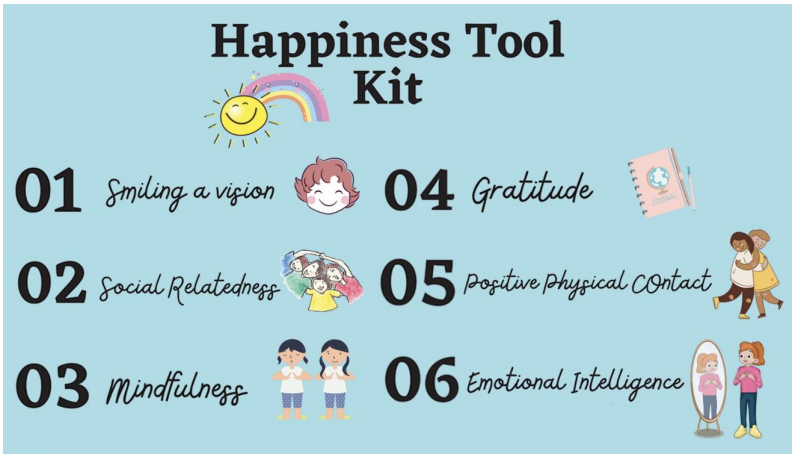
The six components of the toolkit include smiling a vision, social relatedness, mindfulness, gratitude, positive physical contact, and emotional intelligence, as seen below in Figure 1.
Figure 1. The Happiness Toolkit.
When ‘smiling a vision’, children are shown how to visualise themselves in the future, engaging in positive activities that make them happy or think of memories that made them happy. For example, they may visualise themselves in the near future spending time with a family member they trust or in the distant future achieving a long-held goal or dream of theirs. Children are encouraged to smile while they visualise these positive thoughts to further strengthen the positive mental health benefits11. Having goals and a purpose in life has been shown to possibly be one of the many mechanisms underlying resilience, which can offer children protection from negative events they may encounter going forward12.
The pillar of social relatedness encourages the child to spend time with friends or family and participate in community-based events such as sports teams. Parents are encouraged to implement the 5 Rs of healthy brain development into their everyday routine. These include Reading, Rhyming, Routine, Reward and Relationships13. Parents are also encouraged to be present with their children when spending time with them, which can sometimes be difficult with increasing device use becoming normalised in everyday life11.
Mindfulness has long been shown to lead to many positive mental health benefits, including improved behavioural regulation and perceived mental well-being14. Children are encouraged to engage with mindfulness through age-appropriate activities, including deep breathing techniques, diaphragmatic breathing, appreciating the beauty of their surroundings, and spending time in nature11. It is hoped that practising mindfulness will allow children to develop coping mechanisms that they can continually use.
Children are encouraged to practice gratitude by completing a ‘Happy Diary’ where they can either start each day by noting three things they are grateful for or end the day by writing down what made them happy. This is thought to reinforce their positive thoughts and develop their resilience11.
Positive physical contact has been shown to set off physical cascades, such as the release of oxytocin, which can help to make a child feel safe and happy. Engaging in positive physical contact, such as hugs, when doing other activities, such as reading bedtime stories, can increase the child’s well-being and reduce their likelihood of experiencing negative psychological responses such as stress15.
During childhood and adolescence, emotions can be difficult to regulate. Emotional intelligence can be nurtured by teaching young people to be empathetic and self-affirmed and to integrate kindness towards themselves and others when experiencing challenging emotions.
These techniques have been proven to develop resilience, boost self-esteem and promote positive mental health in children11, which could be invaluable for children awaiting input from psychology and CAHMS.
This study aims to explore whether The Happiness Toolkit can help children and their families to engage in positive mental health practices, and whether these practices can lead to the child’s improved mental health, or cessation of symptoms, in the inpatient setting.
Methods
A retrospective chart review was conducted, looking at children under the age of 16 with behavioural and mental health disorders who presented to the Paediatric Unit of a Regional Hospital in Ireland between May 2022 and September 2023 and received intervention using the Happiness Tool Kit.
The data collected did not include any identifiable information and was stored on Microsoft Excel spreadsheets.
After an initial chart review, a total of 13 patients were deemed eligible for inclusion in the study based on the above criteria. The following data was collected from each patient: age, gender, date of presentation to hospital, date of discharge, duration of stay, symptoms, gender dysphoria (yes/no), whether they were experiencing suicidal ideation (with or without deliberate self-harm), symptoms of anxiety, symptoms of depression, previous drug overdose, whether they were currently linked with CAHMS, CAHMS duration, psychology duration, CAHMS evaluation in hospital (yes/no), date of CAHMS review, their mental state at discharge, average length of stay in hospital, details of follow up, their satisfaction with the HTK, the effectiveness of the treatment, whether their symptoms had resolved, whether they had experienced a relapse, whether they were currently interacting with CAHMS or psychology services.
Results
A total of thirteen patients were deemed eligible for inclusion in the current study. These patients ranged in age from 10 to 15 years, and over two-thirds (69%) of patients were aged between 14 to 15 years old. Over three-quarters (84.6%) of included patients were female, and 72.7% of participants were already linked to CAHMS.
Regarding presenting mental health difficulties, anxiety was by far the leading diagnosis (87.5%), most commonly co-occurring with an eating disorder diagnosis (61.5%), followed by intentional drug overdose (38.4%) - a total of 5 patients presented with intentional drug overdose, and 3 of these patients reported suicidal intention.
Looking at the duration of their time in the hospital, only five patients required more than a one-week inpatient stay, and only two patients required a 2–3-month inpatient stay. The remaining patients were discharged after less than 1 week spent in inpatient care.
61.5% of patients had a review with CAMHS during their inpatient stay; subsequently, 76.9% of these patients were linked with CAMHS after leaving the hospital. However, only 50% of them continued to be linked with psychology or CAMHS at follow-up.
As part of their inpatient management care plan, all patients received the Happiness Toolkit. 100% of the patients expressed that they were satisfied with the Happiness Toolkit intervention during their inpatient stay and follow-up.
Regarding the self-care skills included in the Happiness Toolkit, all 13 patients reported remaining compliant with the self-care skills of smiling a vision, mindfulness and positive physical contact. Twelve patients expressed satisfaction with practising the Hand Brain model. Nine patients expressed satisfaction with social relatedness and positive physical contact.
At follow-up, 100% of patients reported cessation of their symptoms, with only one patient having a recurrence of symptoms, which had subsequently resolved.
Conclusion
This study illustrates how hospital-based intervention in the form of the Happiness Toolkit can benefit children and young people with behavioural and mental health conditions while they wait for CAHMS or psychology input.
These results are very promising regarding the use of this novel model of care alongside input from CAHMS and/or psychology in both treating paediatric mental health conditions and preventing the recurrence of these conditions.
The Happiness Toolkit can be an important tool for paediatricians to use to start conversations about the importance of positive mental health and supporting the development of resilience in children.
Conflicts of interest: none declared.
Funding: there was no specific grant for this research from any funding agency in the public, commercial or not-for-profit sectors.
References
(1) World Health Organization. Mental health of adolescents. 17 November 2021. Available from https://www.who.int/news-room/fact-sheets/detail/adolescent-mental-health.
(2) World Heath Organisation. Global Health Estimates. Available at: https://www.who.int/data/global-health-estimates
(3) My World Survey 2. The National Study of Youth Mental Health in Ireland. B. Dooley, C. O’Connor, A. Fitzgerald, A. O’Reilly. 2019.
(4) Irish Times. Ireland’s growing mental health crisis for children and young people adds to a system under pressure. S. Bowers, 2nd June 2023. Available at: https://www.irishtimes.com/health/2023/06/02/a-pill-for-social-ills-wont-solve-the-growing-mental-health-crisis-for-children-and-young-people-experts-say/
(5) UNICEF. Building the Future: Children and the Sustainable Development Goals in Rich Countries; UNICEF: New York, NY, USA, 2017.
(6) O’Sullivan K, Clark S, McGrane A, Rock N, Burke L, Boyle N, Joksimovic N, Marshall K. A qualitative study of child and adolescent mental health during the COVID-19 pandemic in Ireland. International journal of environmental research and public health. 2021 Feb;18(3):1062.
(7) Barrett E, Richardson SC. Eating disorders during the COVID-19 pandemic. Ir Med J. 2020;114(1):233.
(8) The Journal. Extra €10m for mental health services to include funding for new eating disorder team. D. Pepper, 27th May 2024. Available at: https://www.thejournal.ie/extra-e10m-mental-health-services-new-eating-disorder-team-6390979-May2024/
(9) Irish Times. ‘Growing Crisis’: Thousands more 12 to 15 years olds being prescribed antidepressants. S. Bowers, 2nd June 2023. Available at: https://www.irishtimes.com/health/2023/06/02/antidepressant-prescriptions-for-under-15s-up-130-since-2012-hse-figures-show/
(10) NHS, Oxford Health Drugs and Therapeutics Group. Guidelines for the treatment of depression in children and adolescents. 24th March 2022. Available at: https://www.oxfordhealthformulary.nhs.uk/docs/OH%20G'line%20for%20the%20Tx%20of%20dep'n%20in%20under%2018%20year%20olds%20FINAL.pdf
(11) Power, Edmond; Taaffe, Sarah; McLoughlin, Patricia; Sharif, Farhana (2022): Primary and secondary care approach to paediatric mental health conditions: a novel model of care. Royal College of Surgeons in Ireland. Journal Contribution. https://hdl.handle.net/10779/rcsi.20941225.v1
(12) Schaefer SM, Morozink Boylan J, van Reekum CM, et al. Purpose in life predicts better emotional recovery from negative stimuli. PLoSOne 2013;8: e80329.
(13) High PC, American Academy of Paediatrics Committee on Early Childhood, Adoption, and Dependent Care and Council on School Health. School readiness. Paediatrics 2008;121: e1008–15.
(14) Keng S-L, Smoski MJ, Robins CJ. Effects of mindfulness on psychological health: a review of empirical studies. Clin Psychol Rev2011; 31:1041–56.
(15) Morrison I. Keep calm and Cuddle on social touch as a stress buffer. Adapt Human Behaviour Physiology 2016; 2:344–62.