Leiomyoma of the Toe: A Case Report.
Leiomyoma of the Toe: A Case Report.
Muhammad Azfar Khanzada 1*, Mohamed Sied Ali Mahgoub Elnor 2, Dr. Omer Adil Awadelkarim 3, Tariq yahia sidahmed alatta 2, Qamar Jaleel Akhtar 4
1. Orthopedics, Dr Sulaiman Al Habib Hospital, Riyadh, SAU.
2. Resident Orthopedic, Dr Sulaiman Alhabib Hospital Riyadh, KSA, Riyadh, SAU.
3. Orthopedic Surgery/Orthopedic Resident, Dr Sulaiman AlHabib Suwaidi Hospital, Riyadh, SAU.
4. Consultant Orthopedic Surgeon, Dr Sulaiman Alhabib Hospital Riyadh, KSA, Riyadh, SAU.
*Correspondence to: Muhammad Azfar Khanzada, Orthopedics, Dr Sulaiman Al Habib Hospital, Riyadh, SAU.
Copyright
© 2025 Muhammad Azfar Khanzada is an open access article distributed under the Creative Commons Attribution License, which permits unrestricted use, distribution, and reproduction in any medium, provided the original work is properly cited.
Received: 10 Apr 2025
Published: 22 Apr 2025
DOI: https://doi.org/10.5281/zenodo.15259233
Abstract:
Leiomyomas are common in smooth muscle-rich areas but are extremely rare in distal extremities such as the toes. This case report presents a unique instance of leiomyoma in the fifth toe of a middle-aged male who experienced pain and localized swelling for six months.Diagnostic imaging and histopathological evaluation confirmed the lesion as a leiomyoma. Following surgical excision, the patient had complete symptom resolution, with no recurrence at follow-up.This report highlights the rarity of leiomyoma in the toes, underscores the importance of thorough diagnostic evaluation, and provides insights into optimal surgical management. Raising awareness of such atypical presentations can aid clinicians in timely and accurate diagnoses.
Keywords: lesion, histopathology, toe pain, soft tissue tumor, leiomyoma.
Leiomyoma of the Toe: A Case Report.
Introduction
Leiomyoma are rare yet significant harmless protuberance that originate from involuntary non- striated muscle predominantly found in the womb, gastrointestinal tract, and skin. When these tumors occur in atypical locations, such as the foot or toe, they pose distinct diagnostic challenges due to their rarity and the overlapping clinical presentations with other soft tissue masses [1,2,3]. Vascular leiomyoma, or angioleiomyomas, are especially important to recognize. First described in the mid-20th century, angioleiomyomas are defined by their vascular origin and distinct histopathological characteristics, accounting for approximately 4.4% of all benign soft tissue tumors [3,4]. Despite their low prevalence, these tumors lead to considerable localized pain and functional impairment, particularly when located in weight- bearing areas like the foot.
Numerous studies emphasize the diagnostic complexities involved with soft tissue tumors of the foot, highlighting the critical role of advanced imaging techniques-such as magnetic resonance imaging (MRI)-in accurately distinguishing leiomyoma from other benign and malignant entities [2].
This report presents a rare case of a leiomyoma in the toe, detailing its clinical presentation, imaging findings, surgical intervention, and histopathological evaluation. This case is intended to enhance the current body of literature, raise awareness among clinicians, and ensure timely and accurate diagnosis of this uncommon entity [5, 6,7].
Case Presentation
A 41-year-old male presented to the outpatient department at Dr. Sulaiman Al Habib Hospital, Suwaidi, with complaints of pain and a lump on the medial aspect of his right little toe. The swelling was firm, non- compressible, and had been gradually increasing in size. On examination, a 2 × 1 cm raised, firm nodule was identified on the medial side of the little toe, mobile with no erythema or signs of infection.
Imaging Findings
X-ray: Showed a soft tissue shadow not connected to the bone.
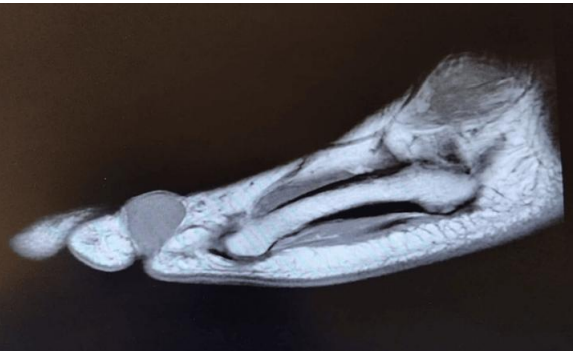
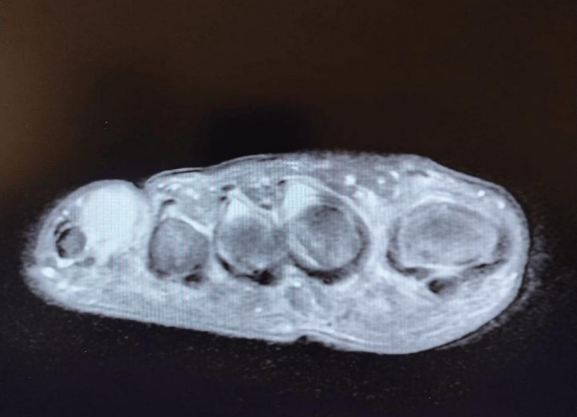
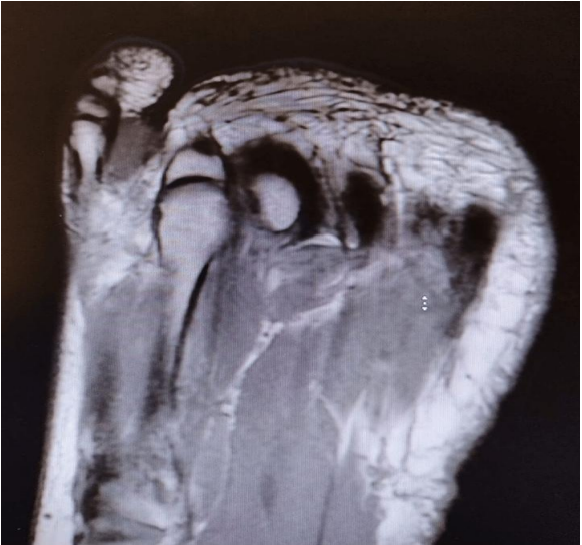
MRI: Revealed an oval-shaped mass on the medial and dorsal aspect of the fifth toe's proximal phalanx, measuring approximately 2 cm. It exhibited intermediate low signal intensity on T1-weighted images and mildly higher heterogeneous intermediate signal intensity on T2-weighted images, closely associated with the flexor tendon (Figures 1, 2 & 3)
FIGURE 1: MRI finding of the lesion (lateral view)
FIGURE 2: MRI finding of the lesion (Aaxial view)
FIGURE 3: MRI view of the foot demonstrating longitudinal soft tissue structures
Surgical Intervention
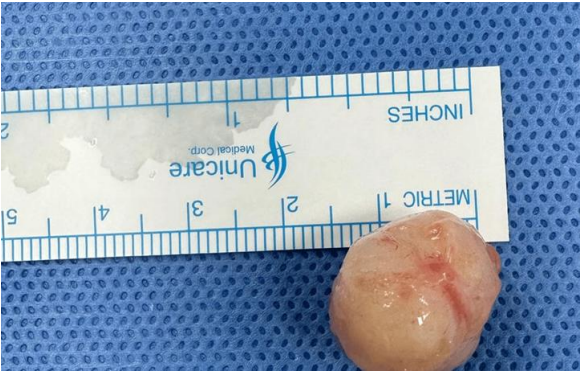
Given the lump's specific location, a giant cell tumor of the tendon sheath was firmly considered as the primary differential diagnosis. The patient was scheduled for an excisional biopsy fortnightly. During the procedure, an entire lesion was removed and forwarded for histopathological analysis. Two weeks after the excision, during the follow-up visit, the incision exhibited remarkable healing. There were no indications of infection, erythema, or discharge, and no traces of the nodule remained (Figure 4).
FIGURE 4: Specimen after complete excision.
Histopathological Findings
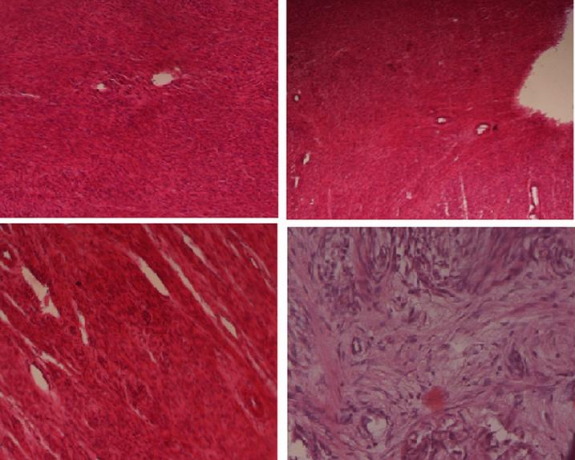
The excised specimen clearly revealed a well-defined spindle cell lesion measuring 1.7 x 1.5 x 1.2 cm. Histological analysis confirmed the presence of fascicles of spindle cells with elongated nuclei, eosinophilic cytoplasm, and indistinct cell borders, indicative of smooth muscle differentiation. Importantly, there was no evidence of malignancy, including increased mitotic activity, nuclear pleomorphism, or necrosis (Figure 5).
FIGURE 5: Histopathology of Leiomyoma
Discussion
Leiomyoma are prevalent in areas rich in smooth muscle, such as the uterus and gastrointestinal tract, but their occurrence in the distal extremities, particularly the toes, is notably rare. This case decisively adds to the limited understanding of these unusual anatomical presentations and emphasizes the necessity of maintaining a broad differential diagnosis for soft tissue masses.
The clinical and imaging features in this case clearly illustrate the significant diagnostic challenges presented by leiomyoma in atypical locations. A painful, firm, localized swelling is a common presentation across various benign and malignant conditions, including giant cell tumors of the tendon sheath, hemangiomas, and sarcomas. However, the absence of systemic symptoms and the preservation of normal vascularity and sensation significantly narrow the differential diagnosis. Ultimately, accurate diagnosis hinges on histopathological evaluation, reinforcing the vital role of advanced imaging modalities like MRI. In this case, MRI provided crucial details about the lesion's size, location, and its relationship to adjacent structures. These findings align with established reports from Kransdorf et al. and others, affirming that MRI is an essential tool in evaluating soft tissue tumors [2].
Histologically, leiomyoma are characterized by fascicles of spindle-shaped cells with eosinophilic cytoplasm, indistinct cell borders, and elongated nuclei, confirming their smooth muscle origin. In this instance, the absence of mitotic activity, pleomorphism, or necrosis robustly excludes the possibility of malignancy.
These findings are consistent with the foundational literature on vascular leiomyoma by Duhig and Ayer, as well as Hachisuga et al., who clearly outline the benign nature and distinct pathology of these tumors [3,4].
Surgical excision is unequivocally the cornerstone of treatment for leiomyoma, as demonstrated in this case. Complete excision not only resolves symptoms but also significantly reduces the risk of recurrence. The favorable postoperative outcome observed in this patient echoes the conclusions drawn by Freedman et al. and Chávez-López et al., who advocate for meticulous surgical management to ensure both symptomatic relief and functional preservation [5].
This case powerfully underscores the importance of recognizing atypical presentations of leiomyoma. A delayed or missed diagnosis can lead to unnecessary morbidity, particularly in weight-bearing regions such as the foot. Clinicians must adopt a multidisciplinary approach involving radiologists, pathologists, and surgeons to guarantee comprehensive evaluation and management. Furthermore, this report highlights the critical value of detailed clinical documentation and histopathological correlation in enhancing the repository of knowledge on rare soft tissue tumors.
Conclusions
Leiomyoma in the toes, while exceedingly rare, must be included in the differential diagnosis of localized soft tissue masses. Early and precise diagnosis, combined with timely surgical intervention, consistently results in excellent outcomes, as demonstrated in this case. Future research should prioritize long-term follow-up and investigation into potential underlying factors to enhance our understanding of the pathophysiology behind these uncommon presentations.
Additional Information
Disclosures
Human subjects: Consent for treatment and open access publication was obtained or waived by all participants in this study. Reserch ethics committee issued approval HMG/ORTHO/SWD/REC/001. the ethical committee have reviewed and approved the the case study submitted by Dr. Muhammad Azfar. All procedures followed ethical standards, and informed consent was obtained from participants where applicable. Conflicts of interest: In compliance with the ICMJE uniform disclosure form, all authors declare the following: Payment/services info: All authors have declared that no financial support was received from any organization for the submitted work. Financial relationships: All authors have declared that they have no financial relationships at present or within the previous three years with any organizations that might have an interest in the submitted work. Other relationships: All authors have declared that there are no other relationships or activities that could appear to have influenced the submitted work.
References
[1]Myhre-Jensen O: A consecutive 7-year series of 1331 benign soft tissue tumors: clinicopathologic data: comparison with sarcomas. Acta Orthop Scand. 1981, 52:287-93. 10.3109/17453678109050105 2.
[2] Kinoshita T, Ishii K, Abe Y, Naganuma H: Angiomyoma of the lower extremity: MR findings . Skeletal Radiol. 1997, 26:443-5. 10.1007/s002560050264 3.
[3] Duhig JT, Ayer JP: Vascular leiomyoma: a study of 61 cases . Arch Pathol. 1959, 68:424-30.
[4] Hachisuga T, Hashimoto H, Enjoji M: Angioleiomyoma: a clinicopathologic reappraisal of 562 cases . Cancer. 1984, 54:126-30.
[5] Freedman AM, Meland NB: Angioleiomyomas of the extremities: report of a case and review of the Mayo Clinic experience. Plast Reconstr Surg. 1989, 83:328-31.
[6] Cerofolini E, Landi A, De Santis G, Meiorana A, Canossi G, Romagnoli R: MR of benign peripheral nerve sheath tumors. J Comput Assist Tomogr. 1991, 15:593. 10.1097/00004728-199107000-00013
[7] Gajanthodi S, Rai R, Chaudhry RK: Vascular leiomyoma of foot. J Clin Diagn Res. 2013, 7:571-2. 10.7860/JCDR/2013/4457.2829