Endoscopic Ultrasound-Guided Drainage of Infected Walled Off Pancreatic Necrosis
Endoscopic Ultrasound-Guided Drainage of Infected Walled Off Pancreatic Necrosis
Marissa Jansen, BS *1, Ethan Barkley, BS 1 , Corey Mealer, BS 1, Manjakkollai Veerabagu, MD 2
1. Medical Student at Medical University of South Carolina.
2. Affiliated Associate Professor at Medical University of South Carolina.
*Correspondence to: Marissa Jansen, BS, Medical Student at Medical University of South Carolina.
Copyright
© 2025 Marissa Jansen, BS, This is an open access article distributed under the Creative Commons Attribution License, which permits unrestricted use, distribution, and reproduction in any medium, provided the original work is properly cited.
Received: 21 April 2025
Published: 02 May 2025
Abstract:
Infected walled off necrosis of the pancreas is the dreaded complication following an acute necrotizing pancreatitis. It is associated with high morbidity and mortality due to sepsis, SIRS and multiorgan failure which can result in death. Surgical open necrosectomy is associated with increased morbidity. Currently endoscopic ultrasound guided drainage has become a minimally invasive approach for this serious condition. We report a case in which the infected walled off necrosis was treated by endoscopic ultrasound guided drainage and necrosectomy with complete resolution of this condition without any serious adverse effects.
Keywords: endoscopic ultrasound (EUS), walled-off necrosis (WON), alcoholic pancreatitis, necrosectomy, lumen apposing metal stent (LAMS)
Endoscopic Ultrasound-Guided Drainage of Infected Walled Off Pancreatic Necrosis
Case History:
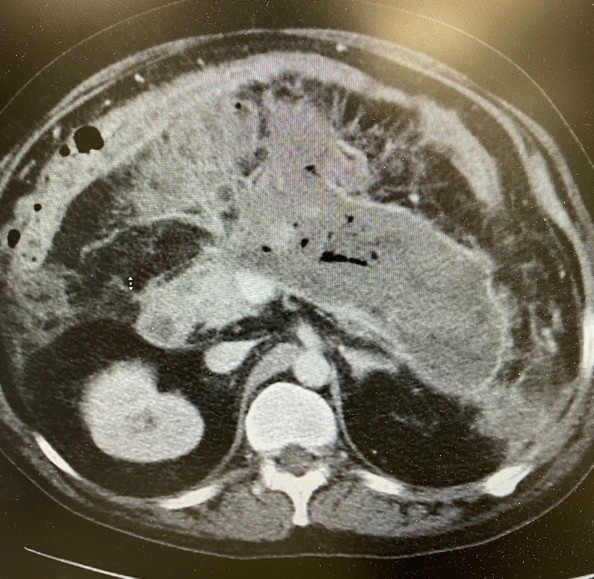
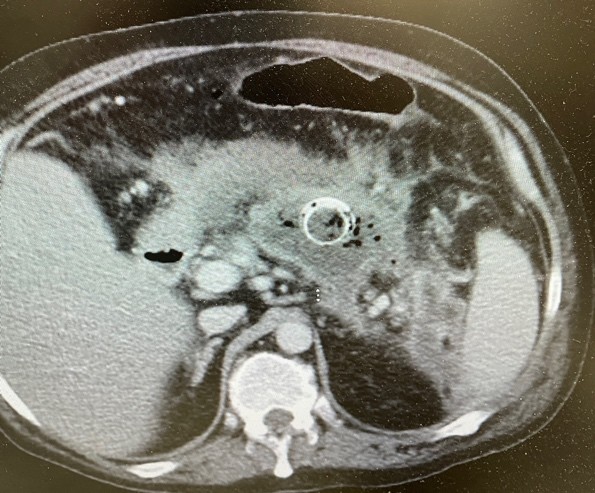
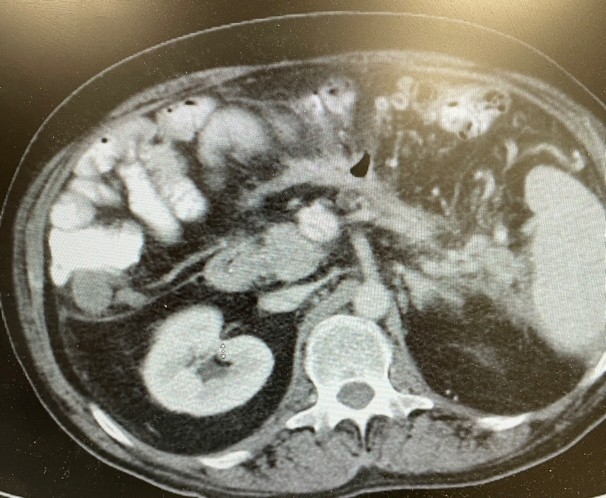
The patient is a 44-year-old male who was initially admitted to the hospital in October 2024 for alcohol-induced acute necrotizing pancreatitis. He was managed by supportive care and he was able to be discharged after 10 days of hospitalization. He was admitted after three weeks of illness with fever, chills and increasing abdominal pain and poor oral intake. CT imaging study showed air in the pancreatic necrotic cavity measuring 24.8 cm x 11.6 cm (Figure 1). EUS-guided drainage was performed using 20 mm x 10 mm lumen apposing metal stent (LAMS), hot Axios (Boston Scientific Corp). The necrotic cavity was visualized using linear array echoendoscope (Olympus America) and using the electrocautery tip of the stent, the wall of the necrotic cavity was punctured from the stomach; the distal flange was deployed inside the cavity and the proximal end of the stent was released under endoscopic guidance.
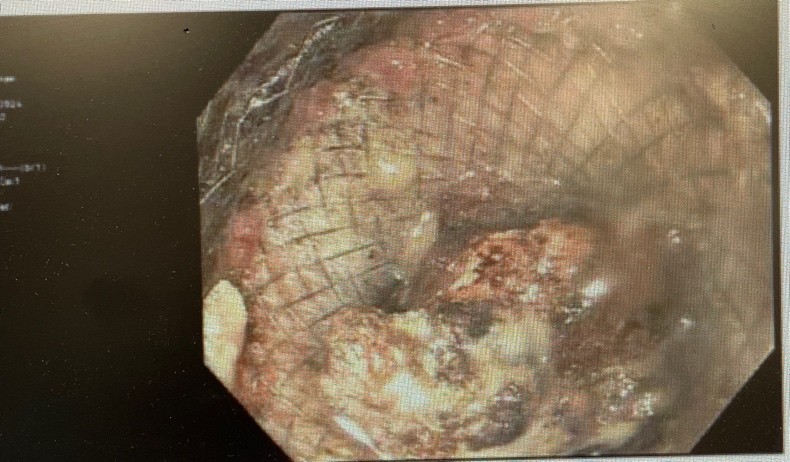
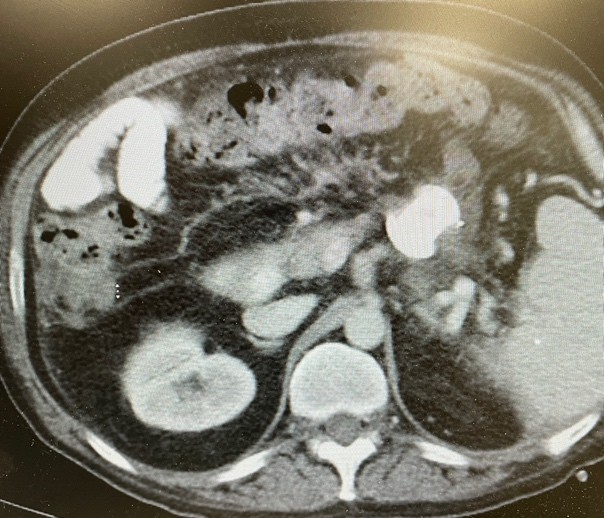
At the time of the initial EUS-guided drainage, the patient was only three weeks post-pancreatitis hospitalization. Due to the thin wall of the cavity, immediate necrosectomy was not performed since there was an increased risk of perforation. A week later he underwent necrosectomy. The procedure involved passing a double channel therapeutic scope into the esophagus and advanced into the stomach. EndoRotor powered endoscopic debridement catheter (Interscope), snare, and forceps were also used to remove the necroma from the cavity. The necrosectomy procedure had to be repeated three times due to the large size and mild bleeding to completely evacuate all the contents from the necrotic cavity. The repeat imaging showed complete healing and obliteration of the cavity and LAMS was successfully removed (Figure 2). There was a small left lower quadrant pelvic collection which could not be accessed by endoscopic ultrasound and was drained by the interventional radiologist. The drain was removed after complete resolution of the small collection. The patient returned to full time work and made a complete recovery without any sequela, such as kidney injury, lung injury or fistula formation.
Discussion
Compared to pseudocysts, necrotic collections have had lower treatment success rates, require multiple interventions, have higher rates of certain adverse events and prolonged hospitalization (1,3). Due to increased morbidity, open surgical necrosectomy has been replaced by minimally invasive options including endoscopic ultrasound (EUS), percutaneous routes (video assisted retroperitoneal debridement), and laparoscopic approaches. In one randomized study, endoscopic therapy had fewer disease related complications (5.9% vs 40.6% p<0.001), fewer pancreatic or enterocutaneous fistulae (0% vs 28.1%, p=0.001), higher physical health quality of liver scores (p=.039) and lower costs (p=.039) compared to minimally invasive surgery.
Recent observational and randomized studies have repeatedly highlighted the efficacy of endoscopic treatment for necrotizing pancreatitis (2). Direct endoscopic necrosectomy, being minimally invasive, has been shown to reduce the risk of post-procedure organ dysfunction and new-onset sepsis, thereby improving outcomes for patients with infected pancreatic necrosis (7). It is particularly effective in managing laterally located walled-off necrosis that cannot be accessed through traditional transmural drainage (4). The use of a stent-assisted approach facilitates repeated and easy passage of the flexible endoscope, accelerating the necrosectomy process. Furthermore, employing a fully covered self-expandable metal stent helps prevent peritoneal contamination.
In this case report, we highlight how endoscopic interventions for necrotizing pancreatitis are a preferable treatment option, even in patient situations that require a multi-step approach. We corroborate that the utilization of this endoscopic approach ensures that patients can resume oral intake almost immediately, spend less time in the hospital, and will have an expedited post-intervention recovery process.
Figure 1. Infected walled off necrosis. Gas inside the cavity indicating a sign of infection.
Figure 2. Highlights the Lumen Apposing Stent (LAMS).
Figure 3. Necrotic tissue visualized through LAMS.
Figure 4. Resolution of the necrotic cavity.
Figure 5. After LAMS removal.
Reference
1. Baron, T. H., Harewood, G. C., Morgan, D. E., Yates, M. R. (2002). Outcome differences after endoscopic drainage of pancreatic necrosis, acute pancreatitis, and chronic pancreatic pseudocysts. Gastrointestinal endoscopy, 56(1), 7-17.
2. Boxhoorn, Lotte, Fockens, P., Besselink, M. G., Bruno, M. J., van Hooft, J. E., Verdonk, R. C., Voermans, R. P. (2018). Endoscopic management of infected necrotizing pancreatitis: an evidence-based approach. Current treatments in gastroenterology, 16(3), 333-344.
3. Fusco, S., Hanke, G. M., Buringer, K., Minn, L., Blumenstock, G., Schempf, U., Gotz, M., Malek, N., Wichmann, D., Werner, C. R. (2024). Clinical course for pancreatic necrosis and pancreatic pseudocysts due to severe acute or chronic pancreatitis. Therapeutic advances in gastroenterology, 17.
4. Goenka, M. K., Goenka, U., Mujoo, Y., Tiwary, I. K., Mahawar, S., Rai, V. K. (2018). Pancreatic necrosectomy through sinus tract endoscopy. Clinical endoscopy, 51, 279-284.
5. Haney, C. M., Kowalewski, K. F., Schmidt, M. W., Koschny, R., Felinska, E. A., Kalkum, E., Probst, P., Diener, M. K., Müller-Stitch, B. P., Hackert, T., & Nickel, F. (2020). Endoscopic versus surgical treatment for infected necrotizing pancreatitis: a systematic review and meta-analysis of randomized controlled trials. Surgical endoscopy, 34(6), 2429–2444.
6. Tang, P., Zha, Q., Zhou, L., Yang, Q., He, M., Zhu, S., Liu, Y. (2021). Effectiveness of digestive endoscopy and surgery in the treatment of necrotizing pancreatitis: a meta-analysis and systemiatic review. Gland surgery, 10(9).
7. Vyawahare, M. A., Gulghane, S., Titarmare, R., Bawankar, T., Mudaliar, P., Naikwade, R., & Timane, J. M. (2022). Percutaneous direct endoscopic pancreatic necrosectomy. World journal of gastrointestinal surgery, 14(8), 731–742..