Endoscopic Mucosal Resection of a Large Duodenal Adenoma
Endoscopic Mucosal Resection of a Large Duodenal Adenoma
Ethan Mitchell, BS1*, Corey Mealer, BS1, Manjakkollai P. Veerabagu, MD2
1. Medical Student, College of Medicine; Medical University of South Carolina.
2. Affiliate Associate Professor; Medical University of South Carolina.
*Correspondence to: Ethan Mitchell, BS, Medical Student, College of Medicine; Medical University of South Carolina.
Copyright
© 2025 Ethan Mitchell, BS, This is an open access article distributed under the Creative Commons Attribution License, which permits unrestricted use, distribution, and reproduction in any medium, provided the original work is properly cited.
Received: 25 July 2025
Published: 01 Aug 2025
Abstract:
Duodenal adenomas are either sporadic or part of familial adenomatosis polyposis syndrome. They can be ampullary or non ampullary in location and have increased risk of bleeding and malignant transformation. Treatment of duodenal adenomas includes a variety of options including endoscopic mucosal resection, endoscopic submucosal dissection, argon plasma coagulation ablation, or surgery1. The type of treatment largely depends on the size and location of the polyp. Due to the thin wall of duodenum there is increased risks of bleeding and perforation with endoscopic removal of these polyps. In this article, we report a case of a 44-year-old male with a very large non ampullary adenomatous duodenal polyp that was successfully removed by endoscopic mucosal resection and to minimize the bleeding during the resection, preemptive endoscopic ultrasound guided treatment of the feeding vessels by epinephrine was performed.
Endoscopic Mucosal Resection of a Large Duodenal Adenoma
Case
The patient is a 44-year-old male with prior history of hemorrhagic stroke was admitted with symptomatic anemia. His hemoglobin was 2.8 g/dl with low iron indices confirming iron deficiency anemia. Patient did not have any signs of active bleeding in the form of hematemesis, or hematochezia or melena. The patient noted increasing fatigue and palpitation on minimal physical exertion. He did not have any gastrointestinal symptoms. The patient was found to have heme positive normal colored stool suggestive of occult gastrointestinal bleeding. The patient was given packed red cell transfusion and started on Pantoprazole A CTA of the chest, abdomen, and pelvis was ordered which showed no acute findings. After adequate resuscitation he underwent esophagogastroduodenoscopy (EGD) and Colonoscopy examinations. The colonoscopy did not reveal any bleeding lesions, but the EGD showed a large non ampullary sessile 6 cm duodenal polyp in the second part of the duodenum below the ampulla and it was on the posteriolateral aspect. The ampulla was evaluated by duodenoscope and it was normal. Endoscopic mucosal resection (EMR) was recommended as the minimally invasive non surgical option after multi disciplinary discussion.
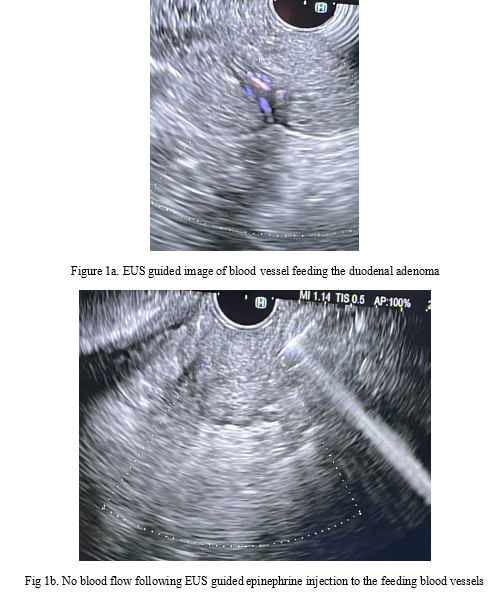
Endoscopic ultrasound was performed to make sure the lesion is not invasive malignant lesion, prior to EMR. A linear array echoendoscope (Olympus America) was passed into the esophagus and advanced into the stomach, and ultrasound imaging of the liver and retroperitoneum appeared fine. The duodenum revealed the large duodenal lesion was indeed mucosal in origin and no evidence of infiltrative malignancy noted. The muscularis propria was intact and no lymph adenopathy noted. The large feeding arterial blood vessel was noted using doppler and 3 mL of 1 in 10,000 epinephrine was injected which resulted in vasoconstriction and doppler showing no blood flow (Figure 1). EMR was performed using gastroscope (Olympus America).
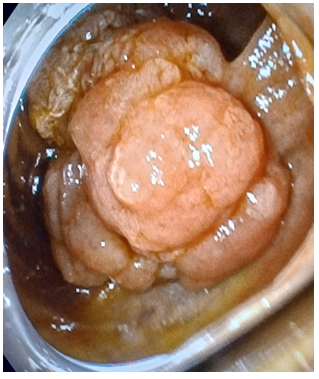
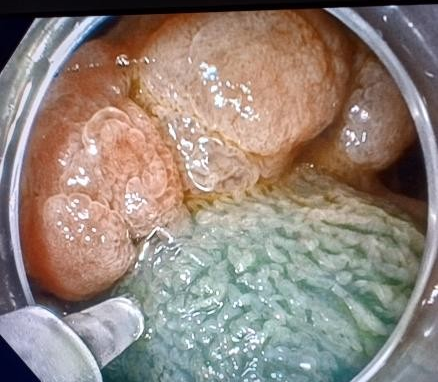
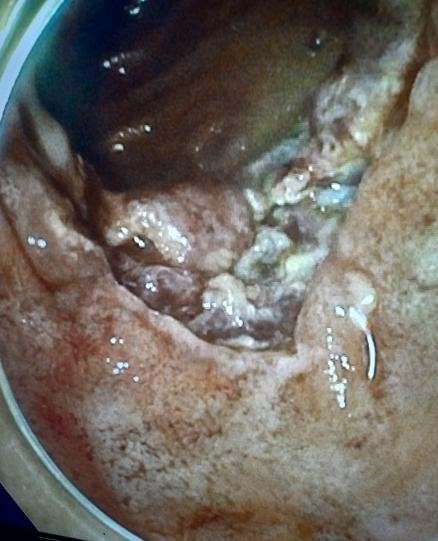
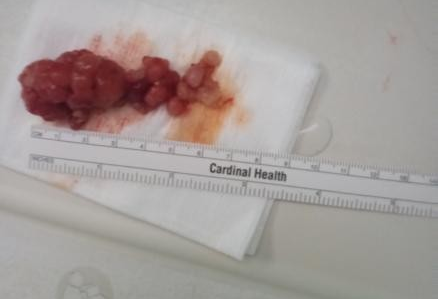
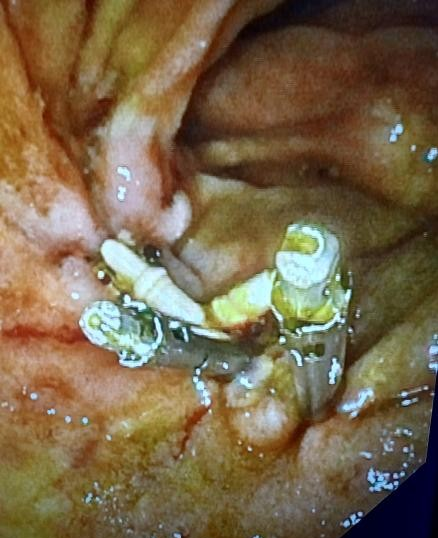
The gastroscope with transparent cap at the end was advanced into the second portion of the descending duodenum. The large adenomatous polyp was seen occupying the majority of the lumen of the duodenum (Figure 2). We then injected epinephrine mixed with lifting agent (Eleview, Cosmo Pharmaceutical, NV), and raised the lesion (Figure 3), and then using 30 mm Captivator snare (BostonScientific) piecemeal resection was done and the entire lesion was successfully excised (Figure 4). The minimal bleeding during the resection was treated by coagulation grasper (Olympus America) using soft coagulation mode (ERBE USA). Then we retrieved all these lesions using Roth net. We retrieved close to 7 cm of this large polyp (Figure 5). After removing all the polyps the mucosal defect was closed using through the scope suturing device X tack (Boston Scientific). There was a small margin at the end and it was closed by two Mantis clips(BostonScientific), (Figure 6). Patient tolerated the procedure well there was no immediate complication. The histopathological examination revealed it was an adenoma with low grade dysplasia and no evidence of malignancy.
There was no complication and he resumed his solid diet immediately and was discharged home in stable condition in few days. Throughout his hospital stay his hemoglobin was stable at 9 g/dl.
Discussion
Duodenal adenomas are precancerous lesions arising either in the ampullary or periampullary or non ampullary areas of the duodenum2. They are sporadic or part of familial adenomatosis polyposis syndrome. In patients with duodenal adenomas, how they are removed largely depends on the size and location of the adenoma. Endoscopic removal is preferred due to minimally invasive nature, fewer complications with quick recovery time. Surgical options include trans duodenal excision, wedge resection, duodenectomy, or pancreaticoduodenectomy. Complications from surgery can include bleeding, damage to adjacent structures, pancreatic leak, and possible changes in bowel patterns that may never revert back to normal3.
Patients with duodenal adenomas can have symptoms such as bowel obstruction, abdominal pain, or occult/overt GI blood loss4. For patients with large polyps causing complications, it is better to perform endoscopic procedures to spare the patient surgery and avoid losing any small intestine if possible. It is important to have close follow up as the recurrence rate even after EMR is high5. This report presents the case of a large duodenal adenoma that caused symptomatic anemia. It was completely removed by endoscopic mucosal resection and the bleeding at the time of the resection was minimized by EUS guided preemptive treatment of the feeding blood vessel. There was no complication and the patient was able to resume oral intake immediately and go home in shorter time without any pains.
Figure 1a. EUS guided image of blood vessel feeding the duodenal adenoma
Fig 1b. No blood flow following EUS guided epinephrine injection to the feeding blood vessels
Figure 2. Large Duodenal Adenoma almost completely obstructing lumen
Figure 3. Raised lesion using epinephrine and Eleview
Figure 4. Lesion after piecemeal removal
Figure 5. Measurement showing 7 cm polyp
Figure 6. Mucosal closure using X tack and mantis clips
References
1. Lim CH, Cho YS. Nonampullary duodenal adenoma: Current understanding of its diagnosis, pathogenesis, and clinical management. World J Gastroenterol. 2016;22(2):853-61.
2. Amoyel M, Belle A, Dhooge M, Ali EA, Hallit R, Prat F, Dohan A, Terris B, Chaussade S, Coriat R, Barret M. Endoscopic management of non-ampullary duodenal adenomas. Endosc Int Open. 2022;10(1):E96-E108.
3. Simon R. Complications After Pancreaticoduodenectomy. Surg Clin North Am. 2021;101(5):865-874.
4. Singh KL, Prabhu T, Gunjiganvi M, Kumar Singh ChA, Moirangthem GS. Isolated duodenal adenoma presenting as gastrointestinal bleed - a case report. J Clin Diagn Res. 2014 ;8(6):ND01-2.
5. Kim GE, Siddiqui UD. Endoscopic Resection Techniques for Duodenal and Ampullary Adenomas. VideoGIE. 2023 ;8(8):330-335.