Needle Stick Injury in a Tertiary Care Eye Hospital in North India: Incidence, Management Outcomes and Recommendation
Needle Stick Injury in a Tertiary Care Eye Hospital in North India: Incidence, Management Outcomes and Recommendation
Anurag Kumar Kashyap 1, Archana Yadav*, Kanishk Khare 1, Prerna 1, Pritish Mathur 2, Puneet Johri 3, Sharad Mishra 4
- IOL Fellow, Sankara eye hospital, Kanpur-209217, Uttar Pradesh, India
- DNB Junior Resident, Sankara eye hospital, Kanpur-209217, Uttar Pradesh, India
- Chief Medical Officer, Sankara eye hospital, Kanpur-209217, Uttar Pradesh, India
- Consultant, Sankara eye hospital, Kanpur-209217, Uttar Pradesh, India.
*. Assistant Professor, Department of Ophthalmology, Rama Medical College, Mandhana Kanpur-209217, India.
*Correspondence to: Dr Puneet Johri, Chief Medical Officer, Sankara Eye Hospital, Kanpur, Uttar Pradesh.
Copyright
© 2023 Dr Puneet Johri. This is an open access article distributed under the Creative Commons Attribution License, which permits unrestricted use, distribution, and reproduction in any medium, provided the original work is properly cited.
Received: 19 October 2023
Published: 01 November 2023
Abstract
Purpose: The purpose of this study is to assess the incidence, management, and outcomes for needle stick injuries (NSIs) in a tertiary eye?care hospital and provide appropriate recommendations for its prevention.
Methods: This was a retrospective database review of NSI recorded between 2015 December and 2023 May at a tertiary eye care center. All staff members who had NSI were managed with standard treatment protocol. The mode, location, health?care personnel affected and/or at risk for NSI were analyzed.
Results: Two hundred and twenty-four NSI were reported over a period of 7.5 years from 2015 December to 2023 April. Ophthalmic fellows combined with postgraduates, suffered maximum needle pricks (n = 105; 46.87%), followed by the nursing staff (n = 62; 27.67%), and consultants (n = 42; 18.75%). The minimum number was reported in the OPD (n = 16; 7.14%). Maximum pricks (n = 59; 26.33%) occurred while passing the sharp instruments and operating (n = 47; 20.98%).
Conclusions: NSI is the most commonly encountered in the operating room among training personnel while passing sharp instruments, especially anterior segment surgeons. A proper needle/sharp disposal mechanism, documentation of adverse event, on?going staff training, and prompt prophylactic treatment are essential components of the protocol for NSI management.
Keywords: Needle stick injury, health?care personnel, Ophthalmic fellows, sharp instruments.
Needle Stick Injury in a Tertiary Care Eye Hospital in North India: Incidence, Management Outcomes and Recommendation
Introduction
Health care personnel (HCP) are prone to accidental exposure to blood and other body fluids or tissues while performing their work duties. National AIDS Control Organization (NACO) defines an HCP as any person, paid or unpaid; working in healthcare settings who are potentially exposed to infectious materials (e.g. blood, tissue, and specific body fluids and medical supplies, equipment, or environmental surfaces contaminated with these substances). Exposure to blood-borne pathogens is a serious occupational safety issue worldwide [1]. Needle stick injury (NSI) is defined as percutaneous exposure where the skin is breached by a needle or any sharp object contaminated by blood or other bodily fluid due to accidental pricks [1,2]. NSI poses a serious risk for occupational transmission of blood pathogens such as human immunodeficiency virus (HIV), hepatitis B virus and hepatitis C virus (HCV) [3]. The average risk of acquiring HIV infection following different types of occupational exposure is low compared to the risk of acquiring infection with HBV or HCV. In terms of occupational exposure, the important routes are needle stick exposure (0.3 % risk for HIV, 9-30 % for HBV and 1- 1.8% for HCV) and mucous membrane exposure (0. 09% for HIV) [4]. NSI can occur during various procedures such as needle recapping, operative procedures, blood collection, intravenous line administration, checking blood sugar, and due to improper sharps/needle disposal [1]. The consequences of a sharp injury reach far beyond the immediate risk of blood?borne virus transmission and can have serious medical and psychological repercussions, as such events are highly stressful and have the potential to affect an individual’s career, family, and patients [5-11].
Given the fact that surgical settings are more blood and fluid-intensive, require manipulation of sharp objects, are chaotic in emergent cases, and demand harmonized member–member interaction, percutaneous exposure incident rates significantly decreased outside the surgical scenes [12]. The field of ophthalmology has always been at the forefront of science and innovation. Advancements in ophthalmic practices have introduced unique microsurgical procedures that additionally increase the risk of sustaining sharp injuries [12]. The risk of instrument mishandling is further exacerbated when visual cues are compromised under high magnification fields combined with minimal room lightning. It is attributed that special circumstances render an ophthalmologist at a greater risk of sustaining NSI as compared to other medical specialties [13]. The number of intravitreal injections performed has increased dramatically over the past decade, becoming one of the most commonly performed ophthalmic procedures as anti?inflammatory, antiviral, antibiotic, and anti?vascular endothelial growth factor inhibitor (anti?VEGF) therapies have emerged as the standard of care in ophthalmic practice and have also increased risk for the ophthalmic personal for NSI [14].
NSI is the second most common cause of occupational injury within the National Health Services [15]. The reported authentic data of NSI in India are scarce due to infrequent reporting [3].
This study therefore attempts to determine the incidence and identify the risk factors for NSI in a tertiary eye care centre in North India over a period of 7.5 years.
Methods
This study was a retrospective database review of all needle prick injuries and splash injuries recorded between 2015 December and 2023 May at a tertiary eye care centre in North India. As a protocol of the institute splash injuries resulting in exposure of mucosal or ocular surface to contaminated bodily fluids were also reported. The institution has 13 fully functional Super Speciality Hospitals across 10 states of the country, equipped for both outpatient & inpatient management. Each center has two to three mobile units in buses for screening cataract patients in the villages, which are accompanied by a well-equipped mobile pathology laboratory for sample blood collection and testing. The institute offers teaching and training to ophthalmic postgraduates, fellows (trainee doctors), nursing staff, optometrists, paramedical staff, and vision care technicians. This study was conducted according to the tenets of Helsinki Declaration. Prior Institutional Review Board approval was obtained. Each subject consented by signing a written informed consent.
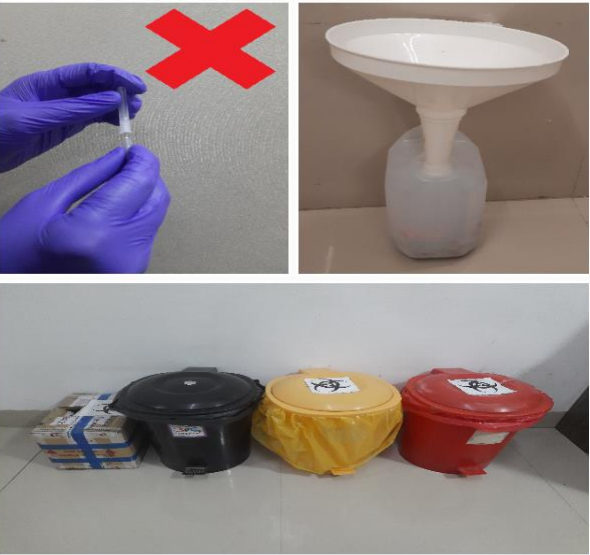
We first conducted a search of the Pubmed database using the keywords “needlestick injuries” and “ophthalmology”. We found only four articles. Data collection and documentation were done by analyzing the hospital’s existing records. Data was segregated and were arranged in preconstructed proforma. Incomplete or vague reports were excluded from the study. Different categorical tabulation was done subsequently. Calculations were done using a digital calculator. Hospital protocol necessitates reporting all sharp injury incidents to the hospital infection control committee (HICC) clinic within 1 hour of occurrence. Reported information includes the mechanism and location of the injury, a description of the context, and the type of instrument involved in the injury. All near misses are reported on different forms and therefore were not included in this study. Every OPD, ward & OT is provided with an adequate number of different colored containers and boxes as shown in Figure 1.
Figure 01
The NSI analysis form is filled out after investigating the cause of injury, and corrective and preventive action is taken in the manner subsequently described. After obtaining their consent, the patient’s and the injured personnel’s blood samples are collected. Counselling of the patient and the injured personnel is done by the concerned physician. Laboratory tests are performed, including HIV screening, in the first 2 h of NSI, and postexposure prophylaxis is conducted within 72 h. If the patient tests HIV positive, antiretroviral therapy is started immediately and continued for 4 weeks in accordance with the NACO 2021 guidelines [4]. The HCP is counselled and assessed for HIV1 and 2 (enzyme-linked immunoassay) antibodies at a 6-month interval. Hepatitis B and C antibodies are tested within the first 2 h and then at third and 6th month intervals. The levels of hepatitis B antibodies are measured for the HCW at the third and 6th month, and if the levels are below 10 mIU/ml, a booster dose of hepatitis B vaccination is administered.
The chief medical officer (CMO) has constituted a HICC that conducts regular training and monitors hospital infection control including universal precaution and post-exposure prophylaxis implementation and quality control. The CMO also ensures that the hospital has a written protocol and Standard Operational Procedures (SOPs) to handle occupational exposure and that those are disseminated to all relevant personnel/departments. All general waste is segregated and disposed of in biodegradable polythene bags which are then placed in big bins designated for the same in the garbage area. The city corporation vehicles daily clear the waste. This is in accordance with the World Health Organization (WHO) protocol for the safe management of waste from healthcare organizations.
Results
Two hundred and twenty-four NSI were reported over a period of 7.5 years from 2015 December to 2023 April. Table 1 shows the year-wise number of NSI and the seroconversion i.e. the number of patients who turned out positive for any three of the three viruses (HIV, Hepatitis B, Hepatitis C). Total number of surgeries performed during the study period of 7.5 years was 81701. The least number of surgeries were performed in the year 2020-2021 while the maximum was achieved in the year 2022-2023.
Ophthalmic fellows combined with postgraduate, training in the institute, suffered maximum needle pricks (n = 105; 46.87%), followed by the nursing staff (n = 62; 27.67%), and consultants (n = 42; 18.75%). The least NSI was encountered by housekeeping/maintenance staff (n = 15; 6.69%), as shown in Table 2.
Table 3 shows the location?wise distribution of NSI, with the maximum number occurring in the OT (n = 159; 70.98%), followed by the ward (n= 27; 12.05%) and the laboratory (n = 22; 9.82%). Within the OT complex, the block room itself accounted for 24.10% ( n =54) cases and the main OR complex 46.87%( n=105) cases.
The minimum number was reported in the OPD (n = 16; 7.14%). Maximum pricks (n = 59; 26.33%) occurred while passing the sharp instruments and operating (n = 47; 20.98%). The NSI encountered while discarding the needles and while administering injection was (n = 34; 15.17%) and (n = 25; 11.16%), respectively, as shown in Table 4.
Table 1,2,3,4
Discussion
It is known that 3–6 billion injections are given per year, of which 60% are unsafe [3]. The incidence of needle injury reported is about 100,000/year in the United Kingdom and about 600,000–1,000,000/year in the United States of America [13]. The ophthalmic theatre is the second most commonly reported location for NSI and accounts for 17% of high?risk sharp injuries as reported by the health practice authority of the United Kingdom in 2007 [15].
Total number of surgeries performed during the study period of 7.5 years was 81701. To the best of our knowledge, this is the first study with data records from such a long duration also including the observations from the Covid-19 pandemic. The least number of surgeries were performed in year 2020-2021. This can be due to the fact that the world was witnessing the Covid-19 pandemic and elective surgical procedures were significantly reduced.
In our study, the highest incidence of NSI was observed among the trainee doctors which included both Ophthalmic fellows combined with postgraduates, accounting for (n = 105; 46.87%) of the total number. This was followed by the nursing staff and consultants, each accounting for (n = 62; 27.67%) and (n = 42; 18.75%) of the total NSI.
Rishi et al. observed that ophthalmic fellows suffered maximum needle pricks (n = 33; 24%), followed by the nursing staff (n = 32; 23%), and consultants (n = 30; 21%) while the postgraduates accounted for (n = 14; 14%) [2].
For us, the maximum NSI was observed among the fellows and residents and can be attributed to the fact that our hospital is a tertiary ophthalmic institute and provides training to a large number of fellows in cataract surgeries and postgraduates in varying ophthalmic subspecialties. The high volume of surgical assistance work and relatively limited wet laboratory experience and surgical learning curve could contribute to such a risk.
Under-reporting of needlestick injuries is widely recognized in the literature [16,17,18]. The rate of under-reported injuries was estimated to be as much as 50% in the United States [19]. Our hospital protocol necessitates reporting of all sharp injuries and splash injuries to the HICC clinic at the earliest preferably within 1 hour of occurrence We found a higher incidence of NSI (2.74/1000 surgeries) in the 7.5 year study period compared to Rishi et al (0.07/1000 surgeries) in the 5 year study period. This could be due to the longer study period including Covid 19 duration and probably higher number of events.
Several methods have been proposed in the literature to minimize the incidence of sharp injury [20,21,22]. One of the widely established methods is hands-free passing, in which a neutral zone is employed as an intermediary area rather than hand-to-hand passing. Stringer et al reported a 60% decrease in incidence rate in operating rooms where hands-free passing method was used [20]. Despite the best efforts to lessen the burden of NSIs by education and training, some injuries are inevitable. The protocol in the event of an accidental NSI is described as Sankara NSI protocol and implemented in all ophthalmic settings. These indicate that an employee must follow the standardized process in case of exposure, immediately notify their supervisor, and begin the process of initiating an incident report. This protocol is in accordance with the Centers for Disease Control and Prevention (CDC) recommendations and the Occupational Safety and Health Standards [23].
Protocol to be followed by exposed individual in case of needle stick injuries /exposure of mucosal surfaces to blood & body fluids.
Figure 2
In our study, the highest number of NSI (including splash injuries) (n = 159; 70.98%) occurred in the OT, followed by the laboratory and ward, accounting (n = 17; 12%) and (n = 14; 10%), respectively. Rishi et al reported similar results as most needle pricks (67%) occurred in OT, followed by the laboratory (12%) and ward (10%) respectively [2].
This can be attributed to the fact that most ophthalmic procedures are conducted in the OT and ours being a tertiary care center, the number of surgeries are higher on a per-day basis and thus increases the chances of NSI in both the OT and the ward.
In our study, the two most common scenarios for NSI in the operating room were while passing sharp instruments by hand which accounted for (n = 59; 26.33%), and while operating which accounted for (n = 47; 20.98%). This was comparable with the results obtained in the study by Rishi et al where they observed highest modality of NSI in the OT was handling of sharp instruments (20%) and Alshihry et al where they observed the maximum number (31%) of NSI while handling instruments during operating procedures [2,5].
Needle discarding procedures are the third most common cause of NSI in our study (n=34; 15.17%) [15,13]. In this study, injuries reported during/after disposal are comparable to Alshihri et al (21%), lower than the one reported in Ghauri et al (46%), but significantly higher than the 4% reported in EPINet [5,13,24]. Injuries in this context are largely observed with hollow-bore needles such as intravitreal injections. In one survey, 8% of retinal specialist have had needle stick injury after Avastin injections [14].
Due to the funnel-shaped design and often lack of safety lids, standard sharp containers are filled quickly leading to overflow if not replaced in a timely manner. HCP should be aware that a sharp container should be replaced if filled to 75% of its capacity. Overfilling containers with additional sharp waste does not necessarily put physicians in danger, instead, it is risky for other healthcare professionals including housekeepers who are trying to empty the containers.
We found the maximum number of pricks (n = 47;20.98%) occurred in 2022 while the least number of pricks (n = 8;3.57%) was observed in 2021. This noticeable rise in numbers can potentially be explained by the fact that following the relaxation of lockdown measures, there may have been a surge in surgical procedures as deferred surgeries were rescheduled. This increase in volume during this period could have contributed to a proportional rise in reported injuries.
Also, the implementation of strict infection-control measures, due to the continuation of the COVID-19 pandemic, may have encouraged medical staff to be more vigilant, leading to more capture of incidents.
The training initiative for NSI prophylaxis was started in 2016 in our institute. Even with the best efforts at educating the staff on a periodic basis, accidental NSI does occur, thus necessitating the need for repetitive and regular training for proper disposal of needles and highlighting the emphasis required for extreme precaution in handling sharps. Several studies have shown that education programs lead to a reduction in the number of sharp injuries [25,26,23].
We observed no seroconversion in all 7.5 years for the staff members exposed to NSI. The CDC estimated the seroconversion rate for HBsAg, HCV and HIV to be 22%–31%, 0.5%, and 0.3%, respectively. The worldwide reported incidence of HIV seroconversion was 296 cases after occupational exposure, of which 56 are documented while 138 were possibly occupationally acquired. In India, two possible cases of occupationally acquired HIV infection have been reported from Chandigarh [27].
This study design is not exempt from certain inherent limitations that should be acknowledged. This is a retrospective study of manually recorded databases in the past 7.5 years with a possibility of variable quality of recorded data being studied. In the initial part of the study period, a few incidents were incompletely recorded regarding data on the mechanism and the description of the context of the injury. This can be due to the fact that over the years a couple of staff were changed.
The Hospital staff & residents in training can feel embarrassed when reporting an injury to an attending physician. Decision-makers should also seek to create a safe culture that encourages reporting without fear of retribution. Audits could be randomly conducted to make sure policies are being followed and assessment of outcomes is carried out periodically.
Given the unique challenges encountered in ophthalmic practice, specialty-specific guidelines should be developed to decrease sharp injuries in the field of ophthalmology. Further prospective research is needed to accurately assess the incidence of sharp injuries and evaluate the compliance of hospital personnel to reporting.
Conclusions
The most common risk factors for NSI in an ophthalmic tertiary care hospital include training personnel performing or assisting in anterior segment surgeries, especially while exchanging sharp instruments. It is in this view that all hospital personnel should be made aware of the risks for NSI, protocol for incident reporting, safe instrument handling, needle disposal mechanisms, and participation in ongoing staff training to reduce and prevent this occupational hazard. Further prospective studies are necessary to evaluate the incidence of NSI among staff workers in an ophthalmic eye hospital and taking active steps in preventing the occurrence of NSI.
References
1. Bidira K, Woldie M, Nemera G. Prevalence and predictors of needlestick injury among nurses in public hospitals of Jimma Zone, South West Ethiopia. Int. J. Nurs. Midwifer 2014;30;(6):90 6.
2. Rishi E, Shantha B, Dhami A, Rishi P, Rajapriya HC. Needle stick injuries in a tertiary eye-care hospital: Incidence, management, outcomes, and recommendations. Indian J Ophthalmol. 2017;65(10):999-1003.
3. Muralidhar S, Singh PK, Jain RK, Malhotra M, Bala M. Needle stick injuries among health care workers in a tertiary care hospital of India. Indian J Med Res 2010; 131:405 10.
4. National Guidelines for HIV Care and Treatment. Available from: https://www.aidsdatahub.org/resource/national-guidelines-hiv-care-and-treatment-2021. [Accessed on 2023 October 02]
5. Alshihry AM. Pattern of Sharps Injuries in Ophthalmic Practice. Epidemiol 2013;3(3):128. doi:10.4172/2161-1165.1000128.
6. Prüss Ustün A, Rapiti E, Hutin Y. Estimation of the global burden of disease attributable to contaminated sharps injuries among health care workers. Am J Ind Med. 2005; 48(6):482 90.
8. U.S. Public Health Service. Updated U.S. Public Health Service guidelines for the management of occupational exposures to HBV, HCV, and HIV and recommendations for postexposure prophylaxis. MMWR Recomm Rep 2001; 50:1 52.
9. Marcus R. Surveillance of health care workers exposed to blood from patients infected with the human immunodeficiency virus. N Engl J Med. 1988; 319(17):1118 23.
10. International Review of Modern Surgery. Infection control: The rising cost of needle stick injuries. Becton, Dickinson U.K. Limited;2005.
11. Rodrigues C. Needle stick injuries &the health care worker – The time to act is now. Indian J Med Res 2010; 131:384 6.
12. Mansour AM. Needlestick injuries in ophthalmology. Ophthalmic Surg. 1989; 20(5):367 9.
13. Ghauri AJ, Amissah Arthur KN, Rashid A, Mushtaq B, Nessim M, Elsherbiny S. Sharps injuries in ophthalmic practice. Eye. 2011; 25:443 8.
14. Shah SU, Koenig MJ, Dacquay Y, Mozayan A, Hubschman JP. Assessment of the risk of needlestick injuries associated with intravitreal injections. Retina. 2014; 34(4):781 4.
15. Adams S, Stojkovic SG, Leveson SH. Needlestick injuries during surgical procedures: a multidisciplinary online study. Occup Med (Lond). 2010; 60(2):139 44.
16. Kennedy R, Kelly S, Gonsalves S, et al. Barriers to the reporting and management of needlestick injuries among surgeons. Ir J Med Sci. 2009; 178(3):297.
17. Bahat H, Hasidov-Gafni A, Youngster I, et al. The prevalence and underreporting of needlestick injuries among hospital workers: a cross-sectional study. Int J Qual Heal Care. 2021; 33(1)–5.
18. Thomas WJC, Murray JRD. The incidence and reporting rates of needle-stick injury amongst UK surgeons. Ann R Coll Surg Engl. 2009; 91(1):12–7.
19. Balkhy HH, El Beltagy KE, El-Saed A, et al. Benchmarking of percutaneous injuries at a teaching tertiary care center in Saudi Arabia relative to United States hospitals participating in the exposure prevention information network. Am J Infect Control. 2011; 39(7):560–5.
20. Stringer B, Infante-Rivard C, Hanley JA. Effectiveness of the hands-free technique in reducing operating theatre injuries. Occup Environ Med. 2002; 59(10):703–7.
21. Stringer B, Haines T, Goldsmith CH, et al. Hands-free technique in the operating room: reduction in body fluid exposure and the value of a training video. Public Health Rep. 2009; 124:169.
22. Linzer PB, Linzer PB, Clarke SP. An integrative review of the hands-free technique in the OR. AORN J. 2017; 106(3):211–18.
23. Brusaferro S, Calligaris L, Farneti F, et al. Educational programmes and sharps injuries in health care workers. Occup Med. 2009; 59(7):512–14.
24. International Safety Center. EPINet Report for Needlestick and Sharp Object Injuries. International Safety Center; 2014:5–9.
25. Tang P, Jamulitrat S, Tang P, Chongsuvivatwong V, et al. Incidence and risk factors for sharps injury among healthcare workers in three hospitals in Kunming, China. J Nurs Sci. 2009; 27(3):42–48.
26. Holodnick CL, Barkauskas V. Reducing percutaneous injuries in the OR by educational methods. AORN J. 2000;72 (3):461.
27. Jayanth ST, Kirupakaran H, Brahmadathan KN, et al. Needle stick injuries in a tertiary care hospital. Indian J Med Microbiol. 2009; 27(1):44-7.