The Role of the United Nations: Helping the World Stay United
The Role of the United Nations: Helping the World Stay United
Riya Singhal *
*Correspondence to: Riya Singhal, Deira International School.
Copyright.
© 2025 Riya Singhal This is an open access article distributed under the Creative Commons Attribution License, which permits unrestricted use, distribution, and reproduction in any medium, provided the original work is properly cited.
Received: 25 June 2025
Published: 01 July 2025
DOI:https://doi.org/10.5281/zenodo.15797938
Abstract
This paper explores the historical background, organizational structure, and global impact of the United Nations (UN) as a central figure in maintaining international peace and cooperation. Since its establishment in 1945, the UN has played a critical role in addressing global conflicts, promoting human rights, providing humanitarian aid, and encouraging sustainable development. This article aims to highlight the continuing importance of the UN in solving modern global challenges through diplomacy and collective action.
The Role of the United Nations: Helping the World Stay United
Introduction
In an increasingly interconnected world, international cooperation is more important than ever. Challenges such as global conflicts, climate change, refugee crises, public health emergencies, and poverty affect not just individual countries, but the entire planet. To address these global problems in a unified and organized manner, the United Nations (UN) was established in 1945. Today, it serves as the world’s most comprehensive platform for diplomatic discussion and collaborative action.
The UN's relevance has only grown over time. As of 2024, the organization has 193 member states, representing nearly every country on Earth. With more than 80,000 personnel currently deployed in 12 peacekeeping missions around the globe, the UN works to prevent conflict, assist in post-conflict recovery, and support democratic processes. Furthermore, its humanitarian agencies deliver aid to over 115 million people each year, including food assistance, shelter, healthcare, and education.
One of the UN’s most ambitious efforts is its promotion of the Sustainable Development Goals (SDGs), a collection of 17 global goals aimed at eradicating poverty, ensuring education, achieving gender equality, and protecting the environment by 2030. According to the United Nations Development Programme (UNDP), over 700 million people still live in extreme poverty, and around 244 million children and youth are out of school globally. These figures highlight the urgent need for coordinated global action — a role the UN is uniquely designed to fulfill.
Moreover, during the COVID-19 pandemic, UN bodies like the World Health Organization (WHO) played a crucial role in distributing information, coordinating international health responses, and supporting the COVAX initiative, which aimed to deliver over 2 billion vaccine doses to low- and middle-income countries.
Understanding the United Nations — how it operates, what it aims to achieve, and the challenges it faces — is essential for the next generation of global citizens. For young learners and future leaders, becoming aware of the UN’s influence helps foster a spirit of unity, global awareness, and civic responsibility in a rapidly changing world.
Historical Background
The United Nations was officially established on October 24, 1945, after the end of World War II. Its creation was based on the failure of the earlier League of Nations, which could not prevent global conflict. Fifty-one countries initially signed the UN Charter, agreeing to work together for peace and development. Today, the UN has 193 member states, nearly every recognized country in the world.
Structure of the United Nations
The UN is composed of several important bodies:
- The General Assembly: A forum where all member nations discuss global issues and vote on key resolutions.
- The Security Council: Responsible for maintaining international peace and security. It has 15 members, including five permanent members with veto power.
- The Secretariat: Carries out the day-to-day work of the UN, led by the Secretary-General.
- The International Court of Justice: Settles legal disputes between countries.
- The Economic and Social Council (ECOSOC): Coordinates global economic, social, and environmental efforts.
Each body has a specific role in ensuring the smooth functioning of the organization.
Key Functions and Achievements
1. Peacekeeping and Conflict Resolution
UN Peacekeepers, also known as “Blue Helmets,” are deployed to regions facing conflict or violence. They do not engage in combat but help maintain ceasefires, protect civilians, and support political peace processes.
2. Human Rights Protection
Through its Human Rights Council and other agencies, the UN works to eliminate discrimination, protect minorities, and promote justice and equality. The Universal Declaration of Human Rights (1948) is one of its landmark documents.
3. Humanitarian Aid
Agencies like UNICEF, UNHCR, and the World Food Programme (WFP) provide life-saving food, shelter, education, and healthcare in crisis zones, especially during natural disasters and wars.
4. Health and Development
The World Health Organization (WHO), a UN agency, has played a central role in controlling diseases like polio, Ebola, and COVID-19. The UN also promotes the Sustainable Development Goals (SDGs) to ensure that by 2030, the world achieves progress in education, poverty reduction, climate action, and gender equality.
Challenges and Criticism
Despite its many achievements, the UN faces several criticisms:
- Veto Power in Security Council: Permanent members can block resolutions, leading to inaction in times of crisis.
- Funding Issues: The UN relies on member contributions. Budget shortages affect its programs.
- Delayed Responses: In some crises, the UN has been criticized for acting too late or being ineffective.
Figure 1
Conclusion
The United Nations remains one of the most important international organizations in the world. While it has limitations, its mission to maintain peace, protect rights, and promote development has had a positive impact on millions of lives. Understanding the UN’s role helps young people become more aware of global issues and encourages them to take part in building a better, more united future.
References
1. United Nations. (n.d.). History of the UN. Retrieved from https://www.un.org
2. UNICEF. (n.d.). Our Work. Retrieved from https://www.unicef.org
3. World Health Organization. (n.d.). About WHO. Retrieved from https://www.who.int
4. United Nations Development Programme. (n.d.). Sustainable Development Goals. https://www.undp.org
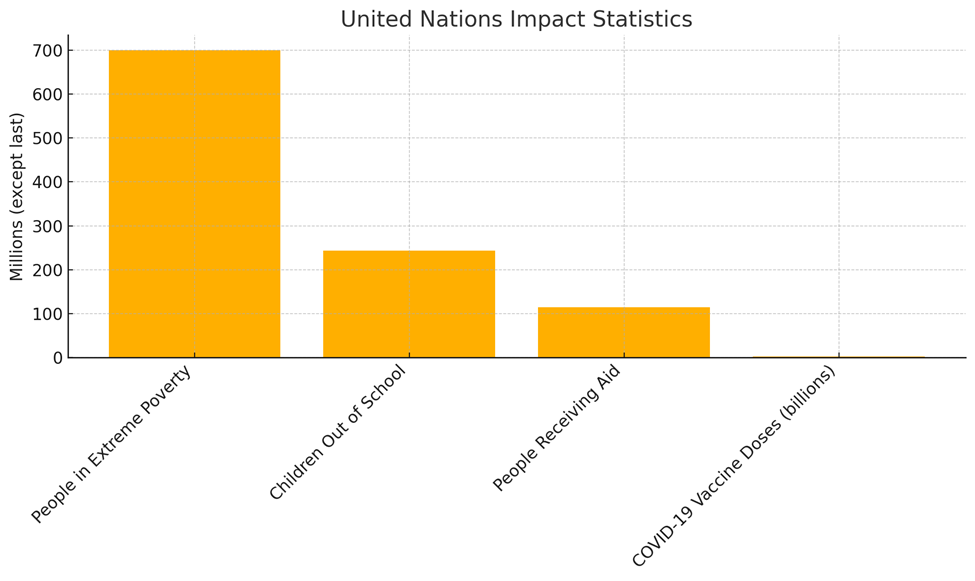
Figure 1